
Table of Contents
Introduction
Watch the 1:64 case in any model shop for sixty seconds. A customer picks up a Skyline, turns it over, checks the badge on the grille, checks the livery against the one already on his shelf, then puts it back or buys it. That is the entire transaction: no demonstration, no explanation, no battery.
Now picture the same body, the same license, the same scale and the same footprint on the shelf — except this one drifts.
That is the argument of this article, and it is not “RC is fun”. It is narrower. The 1:64 collector is the cheapest RC customer a dealer will ever acquire, because he is already standing in your store, already buying at this scale and already comfortable with this price band. Nothing about his habit has to change except what sits inside the box.
We are JXC Model Technology. We build licensed RC cars in Shantou, China and sell B2B only, and we have been shipping to distributors, model shops and hobby retailers in more than 45 countries since 2015 — first as an RC car wholesale manufacturer and now with a licensed range that includes Toyota, Land Rover and Mitsubishi models.
Below you will find why 1:64 is the scale that converts static buyers, what a license actually buys you in a trade negotiation, how one SKU moves basket value, the four objections we hear most from buyers like you, and how to merchandise the car without rebuilding a single fixture.
Why 1:64 Is the Scale That Converts
Most RC ranges fail in a model shop for a boring reason: they belong to a different shelf. Different size, different customer, different conversation. A 1:64 drift car does not ask for any of that.
Scale match is the whole trick
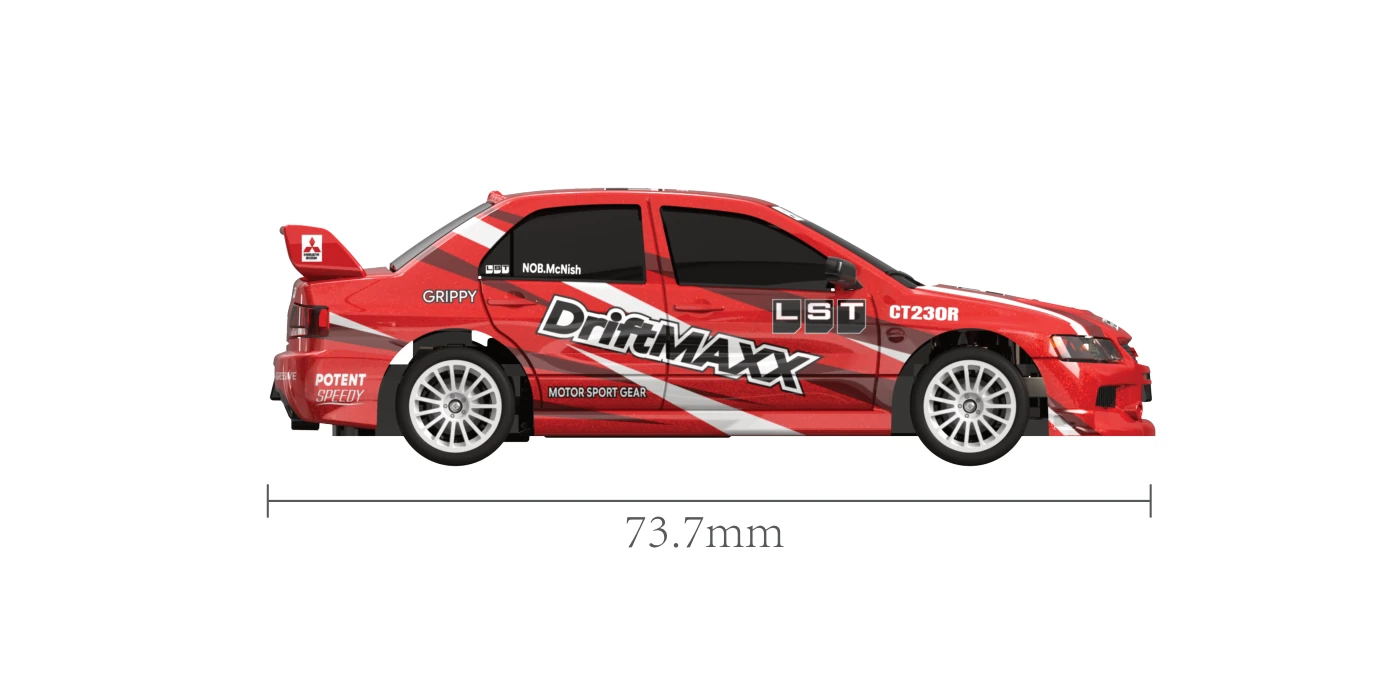
The Lancer Evolution IX measures 73.7 mm long, 32.2 mm wide and 23.2 mm tall. That is a full-proportion car built to the same 1:64 rule as the static models already in your case, so it sits in the same acrylic, on the same shelf, under the same lighting, at the same eye level.
Your customer does not have to learn a new scale, and you do not have to explain one. If he already owns three Evolution models in 1:64, he understands this object before you open your mouth. If you want the wider reference for how scale drives purchasing decisions in this category, our RC car scale chart walks through it size by size.
Display intent survives the upgrade
The reason collectors buy diecast is not that the car is inert. It is that the car is accurate, and accuracy belongs on a shelf. This model keeps that: alloy body, correct stance, working suspension, the livery printed as the real car carries it, and the Mitsubishi Motors licensed mark on the retail box.
It simply also moves when asked. Nothing about the display purpose is traded away for the driving, which is exactly why the swap works for a collector who has never owned an RC car.
No new shelf, no new fixture, no new category decision
For you, the practical consequence is one facing and one SKU. The car goes where the diecast goes. There is no new planogram, no new supplier category to open in your system, no separate returns process. That matters more than any feature list, because a category decision costs a buyer a meeting, and a facing costs nothing.
Practical takeaway: if you sell 1:64 static, you already have the shelf, the customer and the price band. The only missing item is the SKU that moves.
The License Is a Sales Argument, Not Decoration
Plenty of RC cars look like a famous model. Very few are licensed to be that model, and the difference shows up in places that cost a dealer money.
What officially licensed buys you
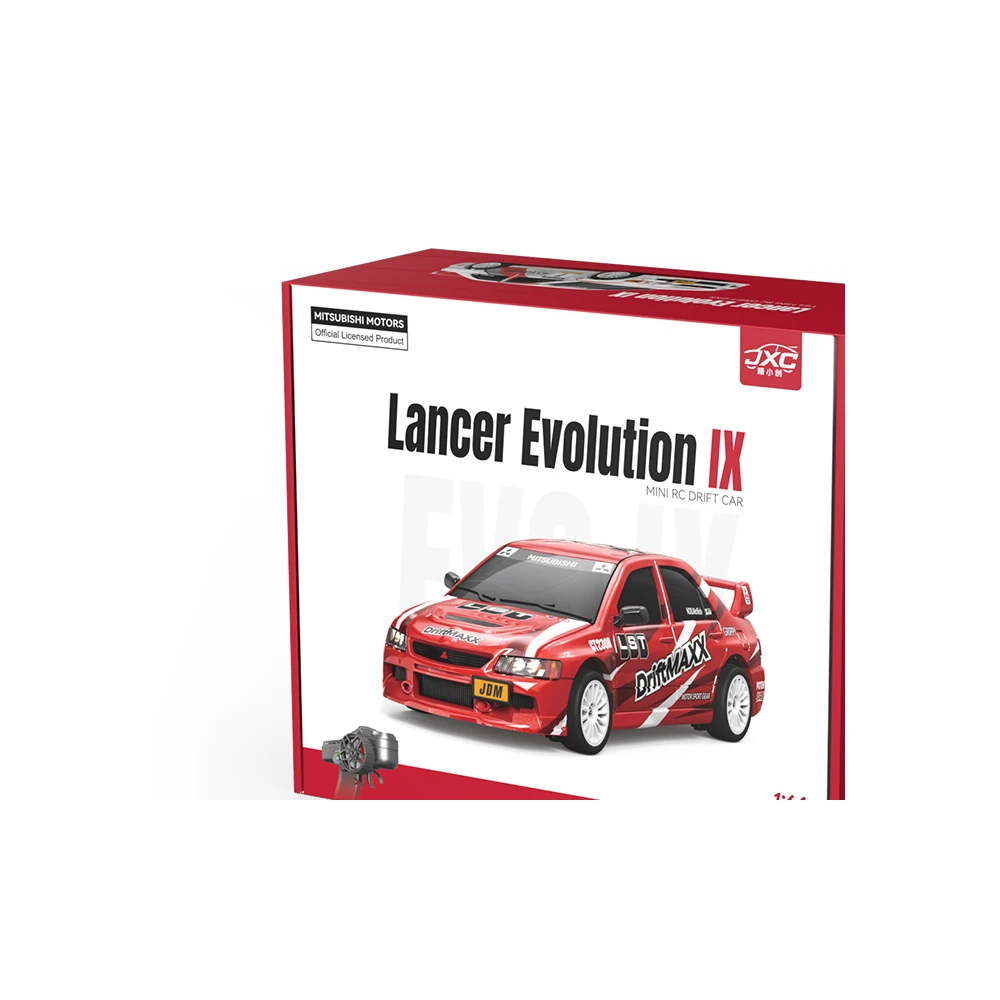
First, the buyer already knows the car. The Evolution IX is one of the most recognizable homologation specials ever built, and a licensed model does not have to teach the badge, the wing or the livery. Second, the packaging carries the Mitsubishi Motors Official Licensed Product mark, which answers the authenticity question before it is asked — at the counter, in an online listing and in a marketplace dispute.
Third, it removes the awkward conversation. When a customer asks whether the car is a real licensed product, your staff has a one-word answer instead of a story.
Two liveries, one mould
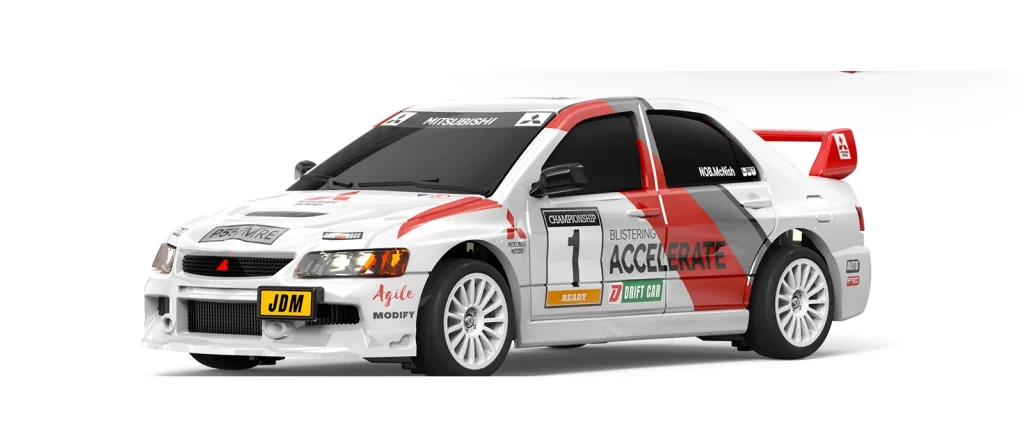
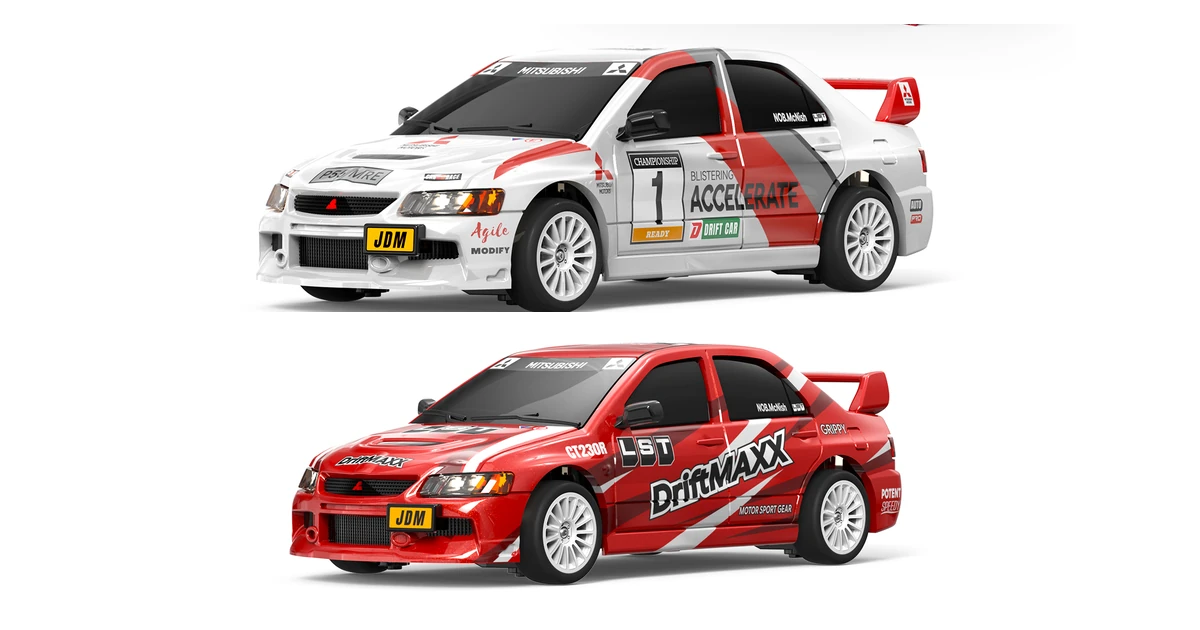
The car ships in two versions: the white ACCELERATE livery and the red DriftMAXX livery. For a dealer this is not color choice, it is a repeat-purchase mechanism. Collectors complete sets, gift buyers pick the color they recognize, and a two-livery range gives you a reason to take a second unit without adding a second product line.
Practical takeaway: sell the license as risk reduction, not as decoration. The badge on the box is what stops the authenticity question from becoming a return.
Shelf Economics: What One SKU Does to Basket Value
The two products share a case, a customer and a price band. What differs is what each one does for the transaction: a static model protects the catalog, a 1:64 RC drift car creates one.
| What it decides | Static 1:64 diecast | 1:64 RC drift car (Lancer Evolution IX) |
|---|---|---|
| Footprint on the shelf | About 75 mm long, standard 1:64 case | 73.7 x 32.2 x 23.2 mm, same case |
| What the buyer does with it | Inspect it, then display it | Inspect it, display it, drive it |
| Age grading | Collector item | 14+, marked as a precision scale model |
| Power | None | USB rechargeable, 25-30 minutes per charge |
| Control | None | 2.4 GHz radio, full proportional steering and throttle |
| Body | Diecast | Alloy body with working suspension |
| Role in the case | Catalogue depth | Demonstration and foot traffic |
| Role in the basket | One-off purchase | Add-on, gift, second livery |
| Restock logic | Assortment depth | Livery pairs plus one demo unit |
Dimensions from the factory multi-view drawing. Livery and control specification as shipped.
The cross-sell path runs in both directions
Static buyer to RC buyer: he is already holding the object, so the demo is a two-minute conversation at the counter, not a category pitch. RC buyer to static buyer: a parent or a collector who came in for a drift car sees the same bodyshell finished as a display model, and buys the shelf piece as well.
Neither direction needs a discount. The second item is adjacent, not alternative.
Repeat purchase logic
Two liveries give you a legitimate reason for a second visit, and gift season doubles the number of buyers per unit without doubling your SKU count. Run the arithmetic on your own numbers: if even a modest share of your static customers takes one drift car, the case earns more per facing than it does today, because the new line does not replace anything.
Practical takeaway: measure the SKU by margin per facing and turns per year, not by how impressive the demo looks. The demo is there to make the turns happen.
Four Objections From Trade Buyers
“My customers buy static, not RC.”
Correct, and that is the opportunity rather than the obstacle. The entry cost for your customer is one unit, not a hobby-grade kit, a charger and a track. He is not being asked to join a hobby; he is being offered the same model he was already going to buy, with a radio in it.
“RC needs space.”
Hobby-grade drifting does. A 73.7 mm car does not. It drifts on a desk, a kitchen table, a tiled floor or a sheet of A3 paper used as a course, and it runs 25 to 30 minutes per charge from any USB source. There is no track build and no workshop.
“I already carry too many SKUs.”
This one replaces nothing. It sits beside existing stock in the same case, in two liveries, and it answers a question your current range cannot: what does this collector do after he has displayed it?
“I don’t want another support headache.”
The car is graded 14+ and marked as a precision scale model rather than a toy, which sets the expectation correctly at the counter. The only wear item is the battery, and the questions your staff will field are the three answered in the FAQ below. If you want spare bodies or packs added to your carton, ask us at the quote stage and we build it into the order.
Practical takeaway: all four objections are really one objection: this is a different category. It is not. It is the same case with a moving part.
How to Merchandise It
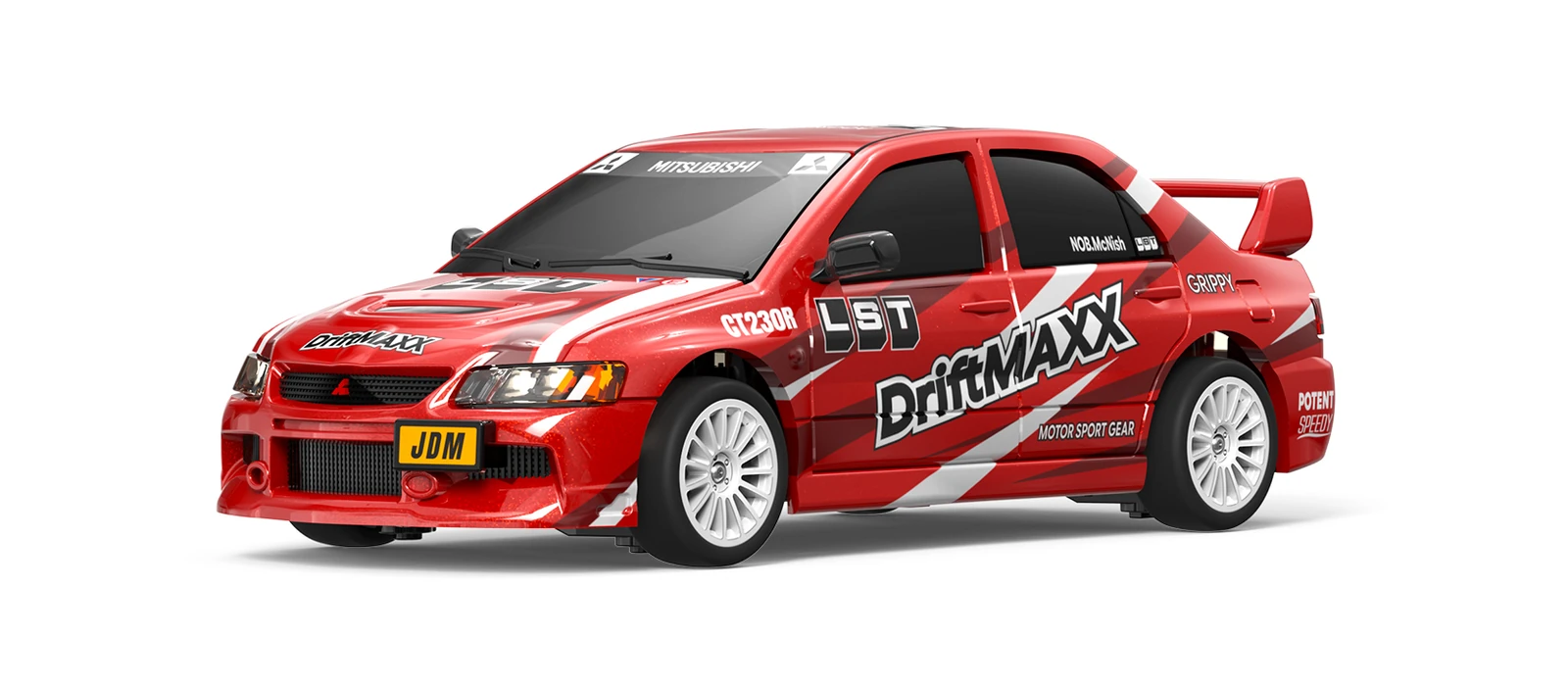
Four moves, all of them cheap.
Place it beside the diecast, not in the RC aisle. If it stands next to the crawlers and the racing cars, it is competing with hobby-grade product on performance and losing. Next to the 1:64 case it is competing on familiarity and winning.
Run a 30-second desk-drift loop at the counter. One hand, one laptop lid, one slide. The clip does the teaching that a shelf card cannot, and it is the same asset you will use on social media.
Put a two-line shelf card under the car. Longest line: 1:64, officially licensed, alloy body, 25-30 minutes per charge. Second line: two liveries. Anything longer will not be read.
Offer the two-piece set. Static model plus drift car, sold as a display-and-drive pair. It is the easiest upsell in the store, because the customer can see both halves on the shelf in front of him.
Practical takeaway: give the car one facing, one clip and one card, and let the customer do the demonstrating.
FAQ – 1:64 RC Drift Cars for Diecast Dealers
Is a 1:64 RC car the same size as 1:64 diecast?
Yes. This model measures 73.7 x 32.2 x 23.2 mm — the same 1:64 rule your static stock follows, so it fits the same case, the same acrylic and the same shelf depth.
Can it actually drift on a desk?
Yes. Proportional steering and throttle let the driver hold an angle and catch it with counter-steer, which is what separates drifting from skidding. A desk, a table or a tiled floor is enough room.
Is it officially licensed?
Yes. It is an officially licensed Mitsubishi Lancer Evolution IX — a model the Mitsubishi Motors rally program made famous — and the retail packaging carries the Mitsubishi Motors Official Licensed Product mark.
What age is it for?
It is graded 14+ and marked as a precision scale model rather than a toy. That is the same positioning as the diecast it sits beside, and it is the right expectation to set at the counter.
What are the supply terms — MOQ, carton, OEM?
They are quoted per market, because carton configuration, mixed-livery packing and OEM packaging all change the number. Ask for the current sheet for your country and channel and you will get terms rather than a range.
Practical takeaway: if your question is not here, our wholesale team answers spec, sample and carton questions in one message.
Ask for the 1:64 Drift Car Wholesale Sheet
We put the trade version of this article into one document: full specification, carton and livery combinations, packaging dimensions and the sample policy, in the form your buying team can circulate internally.
The 1:64 Mitsubishi Lancer Evolution IX RC drift car page carries the same specification in product form once the listing goes live. For a look at how we ran the launch of an earlier licensed drift car, the AE86 release story is the closest precedent.
Send us your country, your channel (model shop, hobby retail, online or distribution) and the volume you are considering, and we will send the sheet with the terms that apply to your market.
Practical takeaway: you already own the shelf. Ask for the sheet and the sample, and test the argument on one case before you commit to a line.
MITSUBISHI, Lancer Evolution and related marks are trademarks of Mitsubishi Motors Corporation. This product is manufactured under official license by JXC Model Technology, an ISO 9001 certified RC car manufacturer in Shantou, China, exporting B2B since 2015.