
Table of Contents
Many distributors ask the same question: “Should I stock entry level vs hobby grade rc cars?” It is a practical sourcing decision. Pick the wrong tier, and inventory can sit too long. Pick the right mix, and your store can build both fast cash flow and stronger per-unit profit.
At JXC Model Technology, we manufacture both entry-level RC cars and hobby-grade RC models for distributors, toy chains, online sellers, and specialty shops. You can review the broader RC car wholesale product lineup while comparing which tier fits your sales channel. We have seen how each tier performs in real wholesale scenarios.
This guide compares entry level vs hobby grade RC cars from a distributor’s point of view. You will see how pricing, MOQ, profit margin, customer expectations, turnover speed, and stock risk differ. You will also see how to build a practical product mix for your sales channel.
Entry-Level vs Hobby-Grade RC Cars: What’s the Real Difference?
Entry-level and hobby-grade RC cars are not simply “cheap vs expensive.” They are built for different buyers, sold through different channels, and supported with different after-sales expectations.
Entry-level RC cars, usually around $25-$60 retail, are made for casual users. Typical buyers include parents choosing a birthday gift, kids getting their first RC car, or shoppers looking for weekend entertainment. These customers usually want simple controls, strong visual appeal, and reliable out-of-box performance.
Hobby-grade RC cars usually sit in the $80-$250 retail range. These buyers care more about proportional control, chassis structure, drivetrain quality, body detail, spare parts, and upgrade potential. They may compare specifications before buying and expect better after-sales support after purchase.
Key differences include:
- Speed and control: Entry-level models often run around
15-25 km/hwith basic steering. Hobby-grade models can reach 30-50+ km/h with more precise throttle and steering control. - Build quality: Entry-level models usually use simpler plastic bodies and snap-on parts. Hobby-grade models may include reinforced chassis, oil-filled shocks, and stronger drivetrain components.
- Repairability: Entry-level products are often treated as replaceable toys. Hobby-grade products benefit from spare parts, repairs, and upgrades.
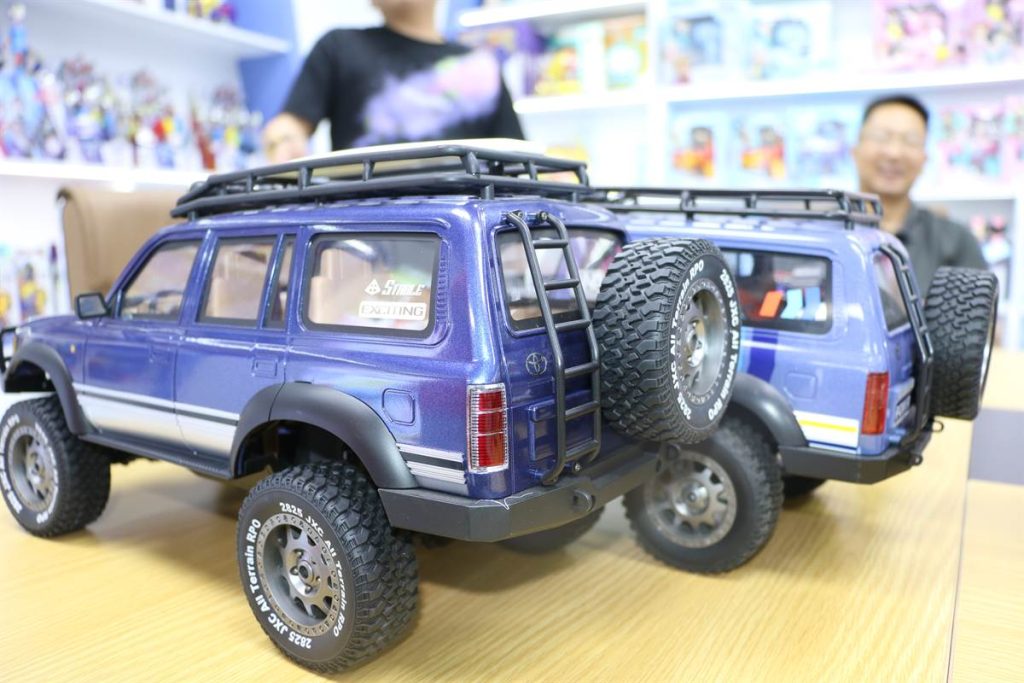
- Licensed body value: Entry-level products are often generic. Hobby-grade buyers are more likely to pay for licensed bodies such as JXC’s Toyota Land Cruiser LC80 1/12 RC crawler and Toyota Supra 1/43 drift car. Licensed body detail can help distributors build stronger product value and higher buyer trust.
For distributors, the practical difference is simple: entry-level models usually sell faster, while hobby-grade models usually create higher gross profit per unit and stronger repeat-purchase opportunities.
Complete Profit Margin Breakdown: Entry-Level vs Hobby-Grade RC Cars
The table below summarizes typical wholesale and retail economics from a distributor perspective.
| Metric | Entry-level RC | Hobby-grade RC |
|---|---|---|
| Unit ex-factory price | $8-15 | $22-65 |
| Typical MOQ | 120-240 pcs | 60-120 pcs |
| Retail price range | $25-60 | $80-250+ |
| Distributor markup | 2.5-3.5x | 2.8-4.5x |
| Per-unit gross profit | $14-38 | $45-150 |
| Return rate | 3-5% | 1-2% |
| Repeat purchase rate | Low | High, including parts and upgrades |
| Inventory turnover | Fast during gift seasons | Steady year-round |
| Certification cost impact | Same per-SKU cost | Same per-SKU cost |
At first glance, hobby-grade RC cars look like the stronger profit choice. They offer higher per-unit profit, lower return rates, and more repeat business from parts, batteries, upgrades, and future model purchases.
However, the table does not show cash flow speed.
- Entry-level RC cars often win on turnover speed. During peak seasons, a well-priced entry-level RC model can move hundreds of units quickly through toy stores, marketplaces, and gift channels. A lower margin per unit can still produce strong total profit when sell-through is fast.
- Hobby-grade RC cars work differently. Sales volume is usually lower, but each customer can become more valuable over time. A hobby buyer who starts with a crawler or drift car may come back for replacement parts, additional batteries, accessories, or another model.
- Hobby-grade buyers also have higher expectations. They notice steering, body fit, battery performance, and spare parts support. If your support is strong, your return rate stays lower and your reputation grows.
The best distributors usually avoid choosing only one tier. They build a controlled mix that uses entry-level products for volume and hobby-grade products for margin.
Which Products Fit Which Store Type?
Different sales channels need different product mixes. A toy shop, hobby store, and online marketplace seller should not stock RC cars in the same way.
Toy Stores and Gift Shops
Toy stores and gift shops usually have high foot traffic and impulse buyers. For this channel, entry-level RC cars should carry most of the assortment.
A practical starting mix is around 80% entry-level and 20% hobby-grade. Entry-level models drive fast sales, while a few hobby-grade models can improve shelf credibility and raise perceived product quality.
Specialty Hobby Shops
Specialty hobby shops serve customers who already understand RC components and performance. For this channel, hobby-grade models should dominate the assortment. Spare parts are especially important because replacement parts and upgrades can become a meaningful share of total RC revenue.
Online Sellers
Online sellers can often use both tiers effectively. Entry-level RC cars help generate traffic, reviews, and price-sensitive sales on marketplaces such as Amazon, eBay, Shopee, or Lazada. Hobby-grade RC cars help build brand value and capture more qualified buyers who search by model type, scale, or licensed body.
A common online strategy is to list entry-level SKUs on marketplaces for volume, then use a branded website or store page to present hobby-grade models with stronger product photography, specification tables, and support information.
Smart Inventory Mixing: How to Reduce Stock Risk
Buying a full container of one RC model may look efficient, but it can increase stock risk if the model, color, or price point does not match your market.
A safer starting strategy is a 60/40 split:
- Put about 60% of the order into entry-level models across
2-3SKUs. - Put about 40% into hobby-grade models across
1-2SKUs. - Use mixed colors or mixed model batches where possible.
- Track sell-through by SKU, not only by category.
- Reorder winners and reduce slow-moving variants quickly.
At JXC, mixed-batch ordering can help distributors test demand before committing to larger volume. For example, instead of ordering one full batch of a single LC80 color, a distributor can test multiple colors or combine compatible models in one shipment where MOQ policy allows.
Replenishment timing also differs by tier. Entry-level RC cars may need restocking every 4-6 weeks during peak seasons. Hobby-grade models may turn slower but more predictably, often needing replenishment every 8-12 weeks depending on channel and market size.
One more practical tip: stock key spare parts early. Even a small spare-parts allocation can reduce after-sales friction and improve customer trust.
Recommended Launch Mix for New RC Distributors
For a new distributor, the best starting mix is usually not the cheapest possible assortment or the most premium-only assortment. A balanced launch lets you learn what your customers actually buy.
A simple launch plan:
- Start with 3 entry-level SKUs to build volume and cash flow.
- Add 1-2 hobby-grade SKUs to protect margin and test serious buyer demand.
- Keep spare parts for your hobby-grade models from the first shipment.
- Review sell-through after the first
30-60days. - Increase stock on the winning tier and reduce slow-moving colors or models.
This approach protects cash flow while still giving your business room to move into higher-value RC products.
FAQ: RC Product Tier Selection
What’s the minimum budget I need to start importing entry-level RC cars?
For entry-level, a first order of 120-180 units across 3 models runs roughly $1,200-2,700 at the factory price. Add shipping and you’re looking at $2,000-4,500 landed. Hobby-grade starter orders are slightly higher — about $3,500-6,000 landed for a 100-unit mixed batch. We’ve had distributors start profitably with either approach.
Which sells faster — entry-level or hobby-grade?
Entry-level, no question. During Q4, a well-priced entry-level RC car can turn inventory in 2-3 weeks. Hobby-grade takes 4-8 weeks on average. But remember: speed isn’t everything. A hobby customer might buy once every two months but spend 3-4x more per year than an entry-level buyer.
Do entry-level RC cars have the same certification requirements as hobby-grade?
Yes. CE, CPC, RoHS, EN71 — the requirements don’t change based on price point. A $10 RC car and a $150 RC car go through the same customs inspection. This is why sourcing from a factory that already holds full certifications (like JXC) matters. You save the $3,000-8,000 per SKU that independent certification testing costs.
Can I sell entry-level and hobby-grade RC cars under the same brand?
Absolutely. Many of our distributors sell JXC’s Supra drift car (hobby-grade, $80-120 retail) alongside our more accessible models under one brand. The key is clear positioning on your store or website. Label them as “Starter Series” and “Pro Series” or similar. Customers understand product tiers.
What’s the most common mistake first-time RC distributors make?
Going all-in on one end of the spectrum. Either they stock only cheap entry-level units and wonder why margins are thin, or they stock only premium hobby-grade and can’t figure out why volume is low. The distributors who succeed fastest are the ones who start with a mix — even a small one — and adjust based on actual customer behavior, not assumptions.
Get Your Free RC Product Tier Profit Comparison Sheet
Want to compare profit scenarios for your own market? JXC can help you review estimated retail pricing, MOQ, shipping assumptions, and product-tier mix for entry-level vs hobby-grade RC cars.
Contact the JXC team through the JXC wholesale partnership page to request current wholesale pricing and a product-tier profit comparison sheet.
We can help you compare entry-level RC wholesale pricing with hobby-grade distributor margins for products like the LC80 crawler, Supra drift car, mixed-batch ordering, and spare-parts planning.