
Table of Contents
Introduction
If you import RC cars for your distribution business, one question keeps coming up at trade shows: “Why does almost every RC toy come from China?” The answer is not just low labor costs. Not anymore. It is about something deeper — a supply chain ecosystem that took 30 years to build and cannot be copied overnight.
We see this every day at JXC Model Technology, maker of the licensed Toyota Land Cruiser LC80 crawler. Our factory sits inside a 50-kilometer radius where you can source every single RC component: motors, ESCs, gearboxes, tires, injection molds, and packaging. That geographic density changes everything about cost, speed, and quality.
In this article, you will learn the real reasons China dominates RC manufacturing — and why does RC toys come from China matters when you are picking a supplier for your next order.
A Complete RC Supply Chain Ecosystem
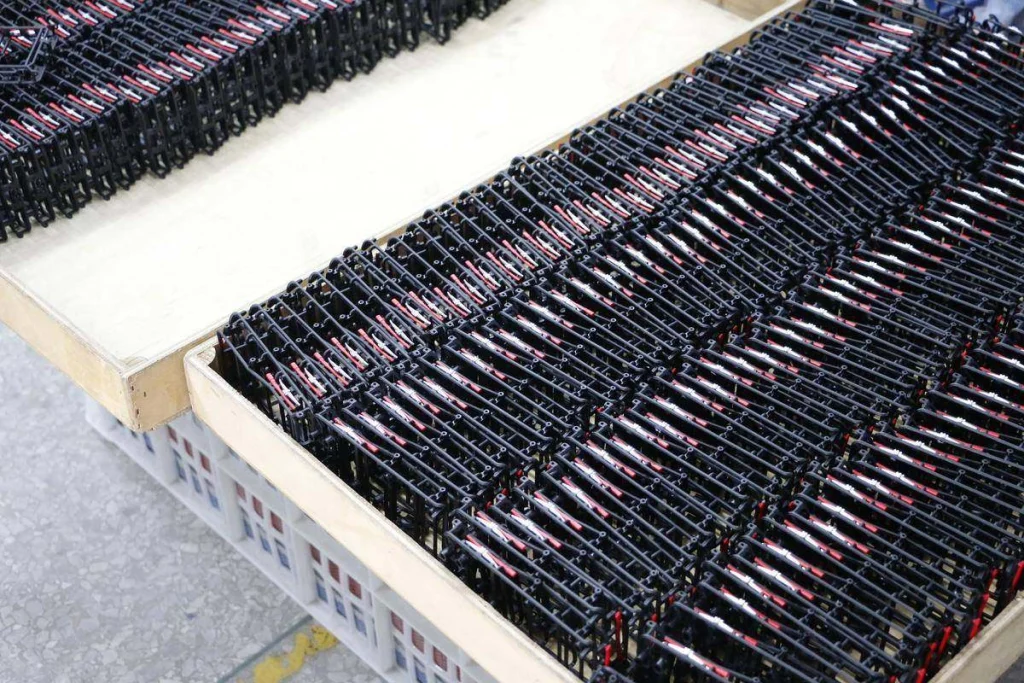
Walk through any RC production hub in Guangdong, and here is what strikes you: it is not one factory making everything. It is hundreds of specialized workshops, each doing one thing extremely well — and this clustering is a big part of why does RC toys come from China in the first place.
The motor shop that winds armatures for a Toyota-licensed RC car? They have been doing just motors for 15 years. The injection molding facility next door runs molds for body shells, chassis parts, and interior details — 24 hours a day, with tooling tolerances down to 0.02mm. The PCB assembly line nearby produces receiver boards at volumes that make the unit cost drop to near nothing. This clustering creates two advantages that no other country matches right now.
First, speed. When our engineers at JXC need a modified gear ratio for the LC80 crawler’s transmission, the gear-cutting shop is a 20-minute drive away. Prototype turnaround: three days. In a fragmented supply chain, that same change takes three weeks and costs four times as much.
Second, cost efficiency does not just come from wages. It comes from shared infrastructure. Electroplating facilities, testing labs, packaging printers — they serve dozens of RC factories, spreading fixed costs across millions of units. One distributor we work with in Germany visited our production area and told us: “I thought I understood scale. I did not.”
The numbers back this up. Guangdong province alone produces over 70% of the world’s RC hobby products. In 2025, China exported more than 480 million toy products globally, with RC vehicles representing one of the fastest-growing subcategories. The supply chain supports everything from $5 toy-grade cars to $500 competition-level chassis — all within the same industrial ecosystem. This is the clearest answer to why does RC toys come from China: no other region has matched this density of specialized suppliers in one radius.
Compare this to emerging production hubs in Southeast Asia. Vietnam and Indonesia have growing toy assembly sectors, but their supply chains still depend on Chinese components for motors, ESCs, and precision gears. A factory in Thailand can assemble an RC car. It cannot yet build every part from local sources. That gap is what gives Chinese manufacturers a structural edge — and one that will take years, not months, for competitors to close.
R&D Capability and IP License Partnerships
Ten years ago, most Chinese RC factories copied designs. That is no longer the business model for serious manufacturers. The shift to original R&D and licensed intellectual property changed the game entirely.
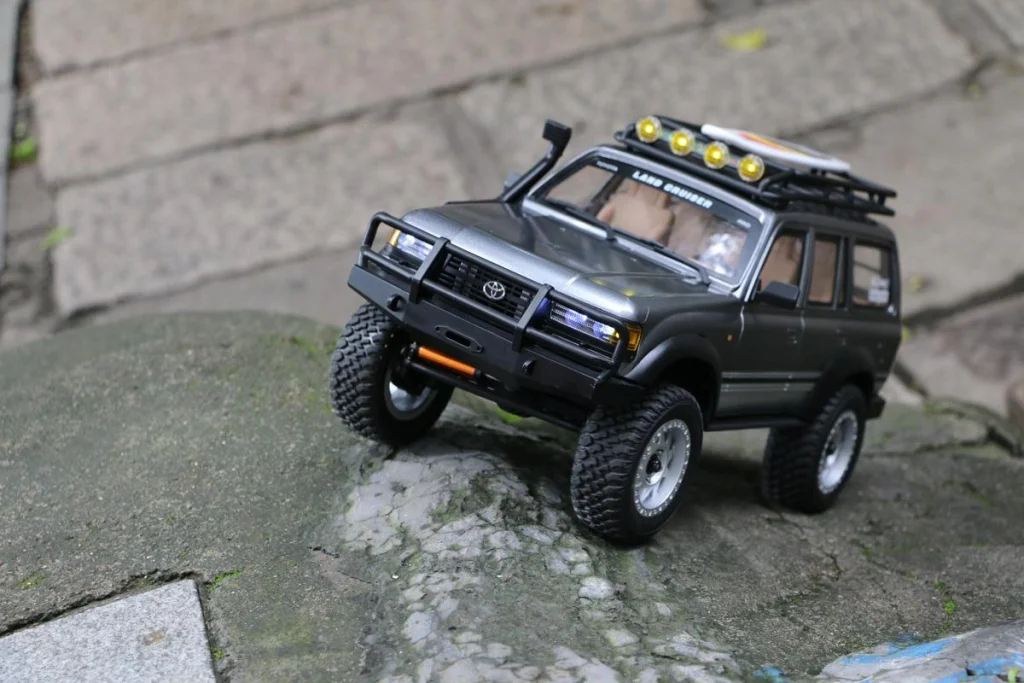
Here is what that looks like on the ground. At JXC, our engineering team does not just assemble parts — they design chassis geometries from scratch. The LC80 1:12 crawler platform went through 14 suspension geometry iterations before we signed off on production. Each iteration involved real-world crawling tests on rocks, sand, and inclines — not just CAD simulations.
Let me give you a concrete example. When we developed the 1:43 Toyota Supra drift car, the challenge was not making it small. It was making it drift like the real car. Our team spent four months tuning the rear-drive bias, tire compound, and steering angle to match the Supra’s actual handling characteristics. That level of detail does not come from a factory that just copies existing designs — and it’s a big part of the answer when people ask why does RC toys come from China instead of a cheaper, faster copycat workshop.
IP licensing adds another layer. Toyota and Mitsubishi do not hand out licenses to any factory that asks. They audit production facilities, check quality systems, verify financial stability, and review compliance records. An audit typically spans three to six months and covers everything from mold precision to paint finish standards. Having those licenses on our wall tells you something real: a third-party global brand already did the due diligence for you. Licensing partnerships like these are another reason why does RC toys come from China — global brands trust factories that have already proven their R&D discipline.
This matters for your business in a direct way. Licensed products sell at 30 to 50 percent higher retail prices than unlicensed equivalents. They clear customs faster because the IP documentation is clean. And they give your store credibility that generic white-label toys simply cannot match.
When you compare Chinese RC manufacturers to smaller workshops in other regions, the R&D gap becomes obvious. A factory that has invested in a 14-iteration suspension development cycle, a four-month drift handling program, and global automotive IP partnerships is playing a different game entirely.
Flexible Production: From Small Batches to Container Loads
One of the biggest myths about Chinese manufacturing is that you need to order massive quantities. That might be true for a generic plastic toy factory pumping out $2 items. It is not true for modern RC manufacturers.
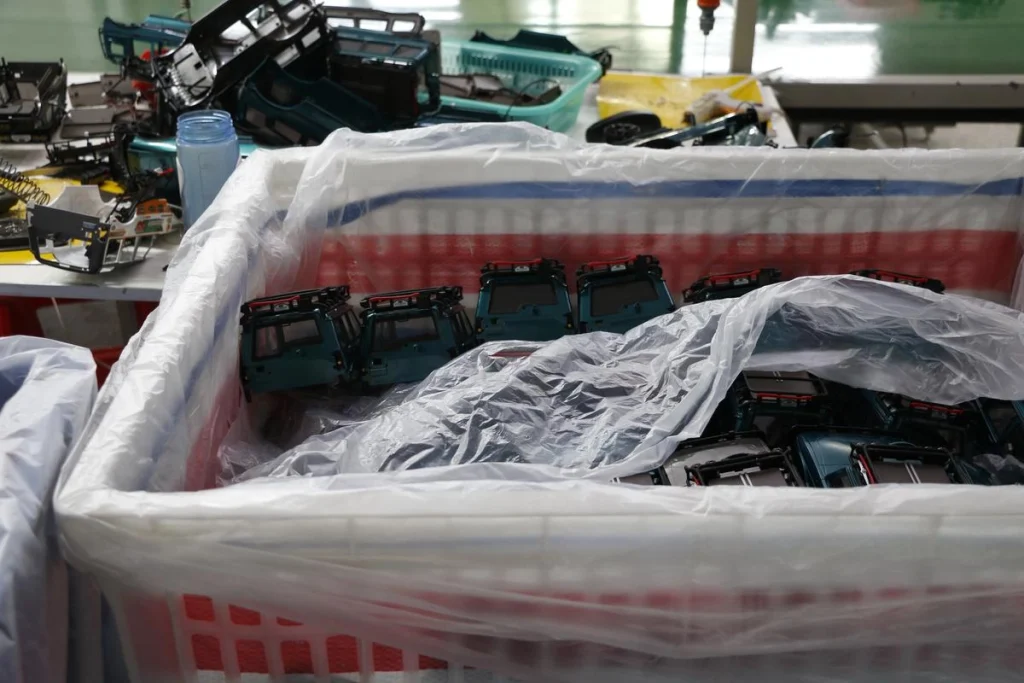
When a distributor in Brazil wants to test the LC80 crawler in their market, they do not want to commit to a full container. They want 50 units: 25 standard versions, 25 with upgraded tires — mixed in one batch. At JXC, we run that order without hesitation. Our production lines are set up for small-batch changeovers, not just endless runs of identical products.
This comes down to factory design. Traditional mass-production lines are optimized for one SKU running for weeks. That works for shampoo bottles. It does not work for RC cars, where distributors need to test multiple models and variants.
We invested in modular assembly stations that switch between LC80 crawler configurations and Supra drift variants in under 30 minutes. The same team that runs a 2,000-unit export order on Monday can pivot to a 100-unit sample run with custom packaging on Wednesday.
What does this mean for you? Three things. Lower upfront inventory risk because you can start small. Faster market testing because you do not wait months for high minimum order quantities. And the ability to mix products — crawlers, drift cars, spare parts — in one shipment to save on logistics.
We had a customer from Poland last year who placed an initial order for 120 units: 40 LC80s, 40 Supras, 20 Delicas, and 20 spare parts kits. All in one 20-foot container. Total turnaround from order confirmation to FOB Shenzhen: 18 days. That is the flexibility advantage in action — and it is something small OEM workshops in emerging markets simply cannot match. This kind of production flexibility is one more piece of why does RC toys come from China rather than smaller emerging hubs.
Complete Export Services: Compliance, Logistics, and Documentation
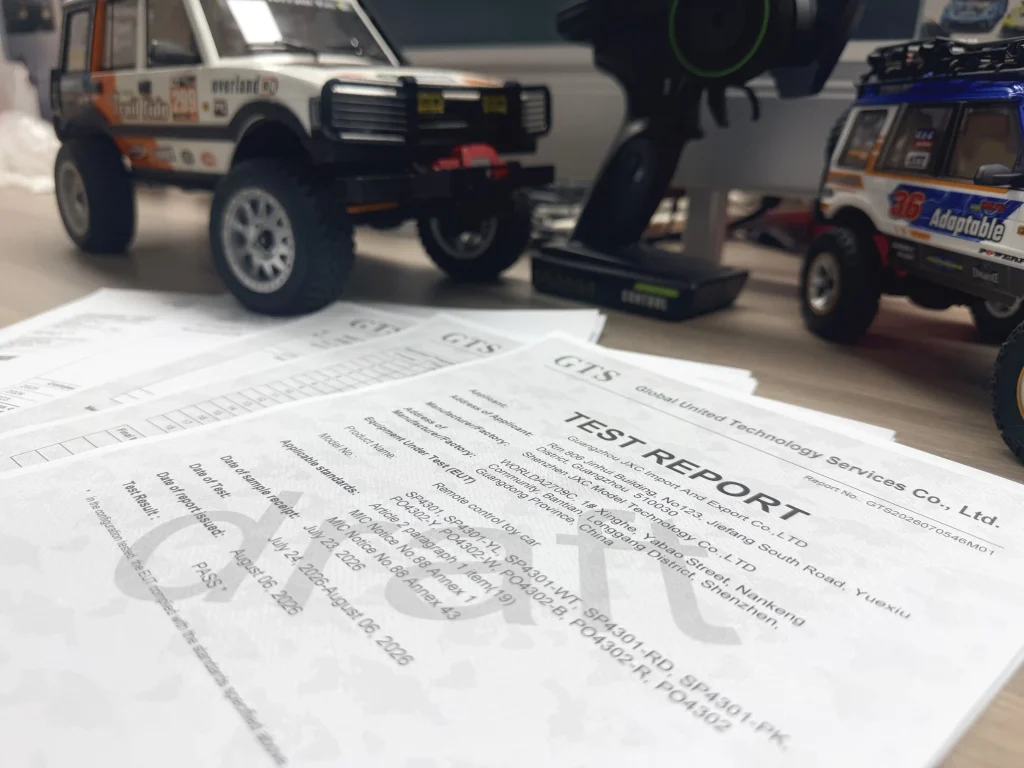
Making a good RC car is one thing. Getting it through customs in 15 different countries is another thing entirely. This is where China’s export infrastructure separates professional manufacturers from the rest.
Every RC car leaving our factory comes with a documentation package: CE test reports for Europe, CPC certificates for the US, EN71 compliance for toy safety, RoHS for electronics, FCC for radio equipment. These are not photocopies. They are valid, verifiable certificates from accredited testing labs — and we include them with every shipment without you asking.
The logistics piece is equally important, and it’s another reason why does RC toys come from China for distributors who cannot afford customs delays. Most professional RC manufacturers work with multiple freight forwarders, giving you options: sea freight for cost-sensitive orders, air freight for rush deliveries, rail to Europe for middle-ground speed and price. Our shipping team at JXC handles FOB, CIF, and DDP terms depending on what works for your market.
Documentation is where many small suppliers fail. A missing form or incorrect HS code can hold your container at port for two weeks — costing storage fees, delaying your retail launch, and eating into margins before you sell a single car. We have been doing this long enough to know every document requirement for every major import market. Our export documentation accuracy rate exceeds 99.5%. Export infrastructure this reliable is a major part of why does RC toys come from China instead of factories still building out their compliance systems.
Let me share something practical. When you compare suppliers, do not just compare unit prices. Ask these questions: Do they provide lab-tested certification documents for every market you plan to sell in? Do they handle FOB documentation in-house or outsource it? What is their average customs clearance time for your target country? The answers will tell you more about real cost than the price per unit ever will.
Frequently Asked Questions
Are Chinese RC factories just cheap because of low labor costs? Why does RC toys come from China if it’s not about cheap labor?
Not anymore. Labor costs in Guangdong’s manufacturing hubs have risen significantly over the last decade. The competitive advantage now comes from supply chain density, specialized expertise, and production infrastructure — not cheap wages. A skilled injection molding technician in Shenzhen earns competitive wages by global standards. The real savings come from the ecosystem, not the payroll.
How do I know if a Chinese RC manufacturer has real R&D capability?
Ask for their design files, not just product photos. A factory with genuine R&D can show you CAD models, prototype iteration records, and test reports. Ask about their engineering team size and backgrounds. At JXC, we are happy to walk distributors through our development process because it proves we are not just an assembler. Look for evidence of iteration — real R&D always involves failed prototypes before the successful one.
Can small distributors work with Chinese RC factories?
Yes. The old model of “container or nothing” is dying. Modern factories like JXC support mixed-batch orders, sample runs, and small initial quantities. You can start with as few as 50 mixed units to test the market. Be upfront about your volume, and find a manufacturer whose MOQ policy matches your business stage — not one that treats every customer like a Walmart buyer.
What is the real difference between a Chinese RC factory and a trading company?
Trading companies do not own production lines. They source from multiple factories, add a margin, and sell to you. A real factory controls its own injection molding, assembly lines, QC processes, and R&D. This matters for quality consistency, pricing, and long-term supply stability. When there is a quality issue, the trading company calls the factory and hopes for the best. When you work directly with JXC, the person fixing the problem sits in the same building as the production line.
How long does it take from order to shipment with a Chinese RC factory?
For standard models without customization, 15 to 25 days is typical for most professional RC factories. OEM orders with custom packaging or branding add 7 to 14 days. The key variable is mold availability — if you need new tooling, add 15 to 30 days for mold development. Always confirm lead times in writing and ask about peak season schedules. Spring and autumn are busy seasons; plan orders accordingly.
Ready to Source from China’s Leading RC Ecosystem?
Understanding why China dominates RC manufacturing is step one. Finding a factory that turns those advantages into real results for your business is step two.
At JXC Model Technology, we bring the full ecosystem to your order: licensed IP products from Toyota and Mitsubishi, complete global certifications (CE, CPC, ASTM, FCC, RoHS, EN71), flexible MOQ with mixed-batch support, and export documentation you can count on — every time.
Looking for a reliable RC manufacturing partner in China? We’d be happy to hear from you. Whether you’re sourcing your first RC products, looking to expand your existing product range, or exploring OEM/ODM opportunities, feel free to get in touch with us. Let’s talk about how we can support your business.