
Introduction
RC car certification is proof that your product meets the toy safety, radio, and chemical rules of the country you sell into. No single certificate covers every market. The United States needs a CPC backed by ASTM F963-23 testing and FCC approval for the remote. The European Union needs CE with EN71. Great Britain needs UKCA. Japan needs ST, PSE, and TELEC.
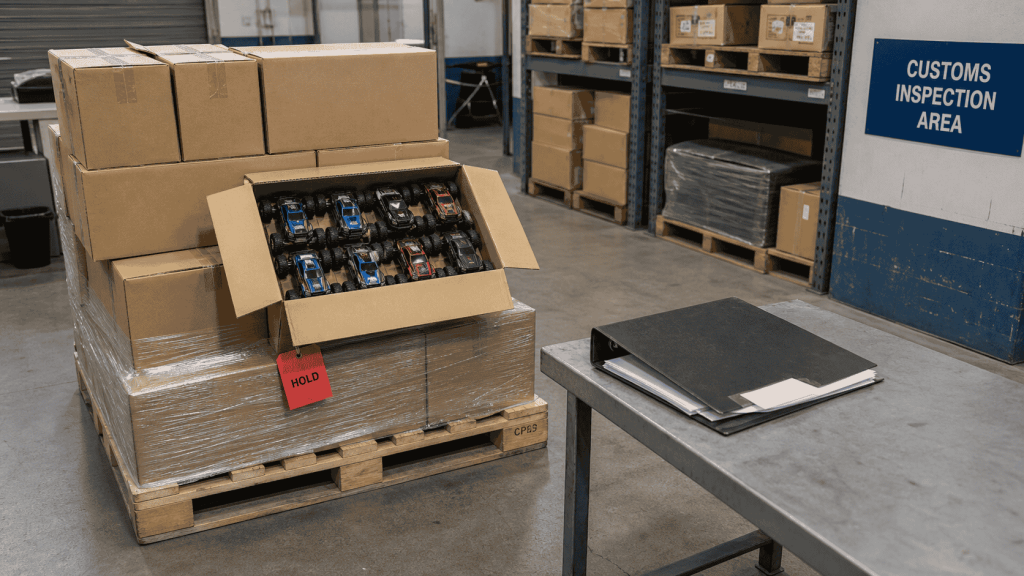
Last year, one of our distributors in Europe lost a full container of RC cars at the border. The shipment had no valid CE documentation. Customs held it for 11 days, then sent it back to China. That mistake cost him more than $18,000 in shipping, storage, and lost sales.
We see this story too often. Many wholesale buyers know RC cars sell well, but they do not know which certificates those cars actually need. The rules change from country to country. One certificate works in the United States but means nothing in the European Union. Another is required in the UK but not in Japan.
At JXC Model Technology, we have shipped RC cars to over 45 countries. We handle CE, CPC, ASTM, FCC, RoHS, EN71, TELEC, and many other certifications every week.
In this guide, we will show you exactly which RC car certification applies to each major market. You will learn what each certificate proves, what happens if you skip it, and how to check if a certificate is real before you pay.
If you are building an RC toy wholesale business, this is the RC car certification checklist you will want to keep on your desk.
RC Toy Export Basics: What Global Certifications Actually Mean
RC car certification is not just a piece of paper. It is proof that a product meets safety, electrical, and environmental rules in a specific country. For RC cars, that matters because these toys contain batteries, motors, radios, and small plastic parts. A child plays with them. A customs officer checks them. A retailer expects them.
We usually group RC car certification into three types. Product safety certificates protect children from physical and chemical hazards. Electrical and radio certificates cover the battery, motor, and remote control signals. Environmental certificates limit harmful materials like lead and cadmium in the plastic and paint.
Let us make this concrete. ASTM F963 in the U.S. tests whether small parts can choke a child under three. EN71-1 in the EU checks the same thing but uses a different test fixture. RoHS limits lead in solder and cadmium in plastic coatings. Each test answers a different question, and you need the right answer for the right country.
A common mistake is thinking one global RC car certification covers everything. It does not. CE marks the European Economic Area. CPC is for the United States. UKCA is for the United Kingdom after Brexit. Each market has its own gatekeeper.
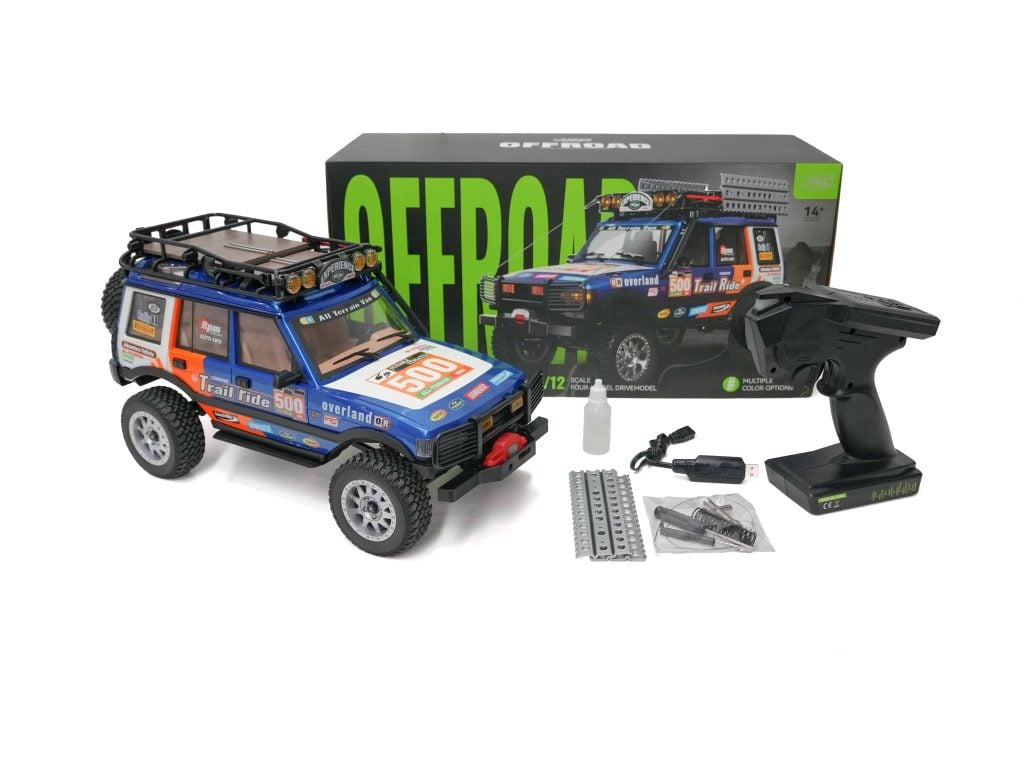
At JXC Model, we prepare full certificate packs for every market before the goods leave our factory. That saves our distributors from surprises at the port. When you ask a supplier for RC car certification, ask for the exact market you plan to sell in. A general test report is helpful, but it is not the same as a market-specific certificate.
Here is a simple rule we share with every new buyer: if the certificate does not name your destination country, it is not enough. A factory that truly exports globally will have separate files for the U.S., EU, UK, Japan, and the Middle East. Anything less is a risk you do not need to take.
Market-by-Market Mandatory Certification Checklist
Below is the same RC car certification checklist our sales team uses when a distributor tells us their target country. We have organized it by the five biggest RC import markets our partners serve.
| Market | Required Certifications | What It Covers | Why It Matters |
|---|---|---|---|
| United States | CPC, ASTM F963, FCC (radio) | Toy safety, physical/chemical testing, radio frequency | CPSC and customs can detain or recall non-compliant toys |
| European Union | CE, EN71-1/2/3, RoHS, REACH | Mechanical safety, flammability, chemical migration, hazardous substances | Required for customs clearance and retailer listing |
| United Kingdom | UKCA, EN71-1/2/3, RoHS | Same scope as CE post-Brexit | Mandatory for goods sold in Great Britain |
| Japan | ST 2016, PSE, TELEC/MIC | Mechanical, chemical, electrical safety, and radio frequency compliance | Required by Ministry of Health and Radio Act |
| Middle East (GCC) | GSO/GCC Conformity, SASO, ECAS | Safety, labeling, and regional technical requirements | Without GCC markings, shipments can be rejected at Gulf ports |
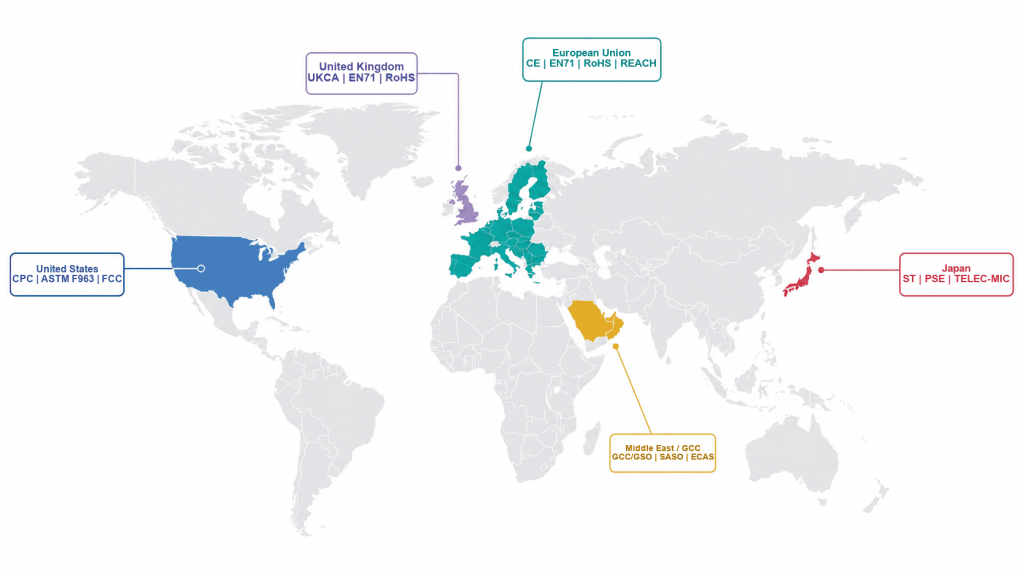
Let us break each RC car certification down a little more. In the United States, the Children’s Product Certificate, or CPC, must be issued by the importer based on third-party lab testing. The supplier should give you the ASTM F963 and FCC test reports, but you, as the importer, sign the CPC. We always provide the lab reports our distributors need to create their CPC quickly.
ASTM F963 covers mechanical hazards, flammability, and chemical properties. FCC covers the radio transmitter in the remote control. If your RC car operates on 2.4 GHz, which most modern cars do, the FCC report proves it will not interfere with other devices. Without it, U.S. customs can reject the shipment even if the toy itself is safe.
In the EU, the CE mark means the manufacturer declares the product meets all relevant directives. For RC toys, that usually means the Toy Safety Directive, the EMC Directive for radio signals, and the RoHS Directive for restricted substances. The EN71 standards are the actual test methods behind the CE mark for toys.
EN71 splits into three main parts. Part 1 tests mechanical and physical safety. Part 2 tests flammability. Part 3 tests migration of certain elements, like heavy metals in paint or coatings. A complete CE pack for an RC car should include all three.
The UK now uses UKCA instead of CE for goods placed on the Great Britain market. Northern Ireland still accepts CE. If you sell into both regions, you may need both marks. We keep both CE and UKCA files ready for our European distributors.
Japan uses the ST 2016 toy safety standard. If the RC car includes a charger or rechargeable battery pack, PSE certification for those electrical parts is also required. In addition, because every RC car relies on a radio transmitter for remote control, it must carry MIC certification — commonly known as TELEC certification — under Japan’s Radio Act. The Ministry of Internal Affairs and Communications (MIC) mandates this approval for any device that transmits radio signals, which includes all 2.4 GHz RC controllers. Without a valid TELEC certificate, Japanese customs can detain the shipment, and the product cannot be legally sold. Our export team checks every Japan-bound order for ST, PSE, and TELEC before shipping.
For the Middle East, GCC marking is the big umbrella. Individual countries add their own labels, like SASO for Saudi Arabia and ECAS for the UAE. We register our RC models with Gulf conformity bodies so our partners can clear customs without delays.
What Happens When Your RC Shipment Lacks the Right Certification
The penalties are not theoretical. In 2024, U.S. Customs and Border Protection reported thousands of toy shipments detained for missing CPC or incorrect ASTM documentation. Many were destroyed or returned at the importer’s expense.
We have seen three main outcomes when certificates are missing. First, customs holds the shipment. Every day in storage adds demurrage fees. A one-week delay can eat the profit margin on the entire order. Second, the goods are refused entry and sent back. You pay freight twice and receive nothing. Third, the product reaches the shelf, a safety issue appears, and the recall process begins. Recalls destroy brand trust and can trigger fines.
One distributor in the Middle East told us he lost a retail listing because his RC cars arrived without GCC marking. The buyer canceled the order on the spot. It took him six months to rebuild that relationship with a different product line.
In the EU, national market surveillance agencies can fine importers and force product withdrawals. In 2023, several RC toys were recalled from the EU market because their chargers did not meet safety standards. The importer, not the Chinese factory, often carries the legal liability.
The hidden cost is time. A shipment stuck at customs during Q4 can miss the entire holiday season. That is why we treat RC car certification as part of the product not an afterthought. When you source from JXC Model Technology, every order ships with the correct certification pack for its destination.
You can avoid most of these problems by asking one question early: which RC car certification do I need for my target market? If the supplier cannot answer clearly, keep looking.
How to Verify Certificates Before You Place an Order
Even when a supplier shows you an RC car certification, you should check it yourself. Fake or outdated certificates are more common than most buyers think. Here is the process our team recommends before any first order.
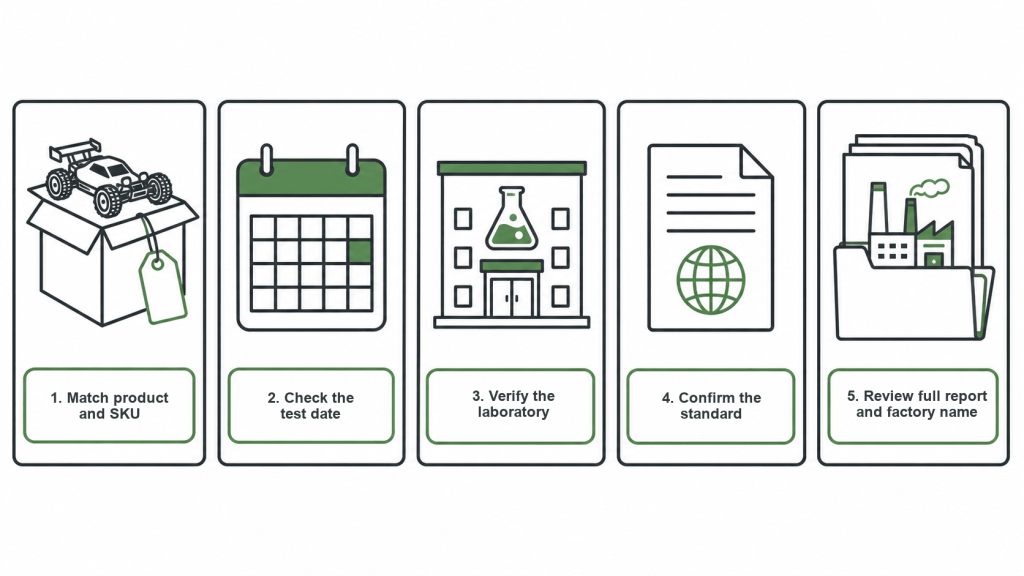
Step one, match the RC car certification to the exact product. A certificate for a 1/43 drift car does not cover a 1/12 crawler. Check the model name, SKU, and photos on the report. At JXC Model, we label every certificate with the exact product code so there is no confusion.
Step two, check that the testing date is recent. Standards change. A report from 2019 may not reflect current ASTM or EN71 requirements. We refresh our test reports whenever a standard updates, and we keep records organized by SKU and market.
Check the testing laboratory. Look for ISO 17025 accreditation. Major labs include SGS, Intertek, TUV, BV, and UL. Search the lab’s accreditation number on the certificate against the official registry.
Confirm the test standard and date. ASTM F963-17 is current for the U.S. EN71-1/2/3 standards are updated periodically. An old standard may not be accepted today.
Ask for the full test report, not just a summary page. The summary can hide failures in individual test items. We share full reports with serious buyers upon request.
Cross-check the factory name. The report should list the actual manufacturer, not a random trading company. If the factory name does not match the supplier, ask why.
If a supplier refuses to share full reports or gives vague answers, treat that as a red flag. A real factory with real certifications has nothing to hide. We encourage every new JXC partner to verify our certificates independently. It builds trust before the first container ships.
RC Certification FAQ
Do all RC cars need the same certificates?
No. The required certificates depend on the target country, the product design, and whether the toy includes radio, batteries, or chargers. Always confirm the exact market before ordering.
Can I use a CE certificate for the United States?
No. CE is for the European Economic Area. The U.S. requires CPC based on ASTM F963 testing and FCC for radio functions. They are separate systems.
Who is responsible for the CPC?
The importer is legally responsible for issuing the CPC in the U.S. The factory should provide the ASTM and FCC test reports, but the importer signs and keeps the CPC.
How long does an RC car certification stay valid?
There is no fixed expiration date for all certificates, but standards update. We recommend checking that test reports are less than two years old and match the current regulations.
Does JXC Model provide certificates for every order?
Yes. We provide market-specific certification packs for the U.S., EU, UK, Japan, Middle East, and other regions. Just tell us where the goods are going.
Get Your Free RC Certification
RC car certification means sorting through CE, CPC, UKCA, FCC, GCC, and ST standards, and that is a lot to remember. That is why we built a simple cheat sheet that lists every major certification by country, what it covers, and what documents to request from your supplier.
Ask the cheat sheet now and keep it next time you review a new RC supplier. If you want us to check whether your current product lineup has the right RC car certification for your target market, send us a message. We will review it with you, no obligation.
At JXC Model Technology, we believe compliance should never be the reason you lose a shipment. Let us help you get it right from the first order.