
Table of Contents
Introduction
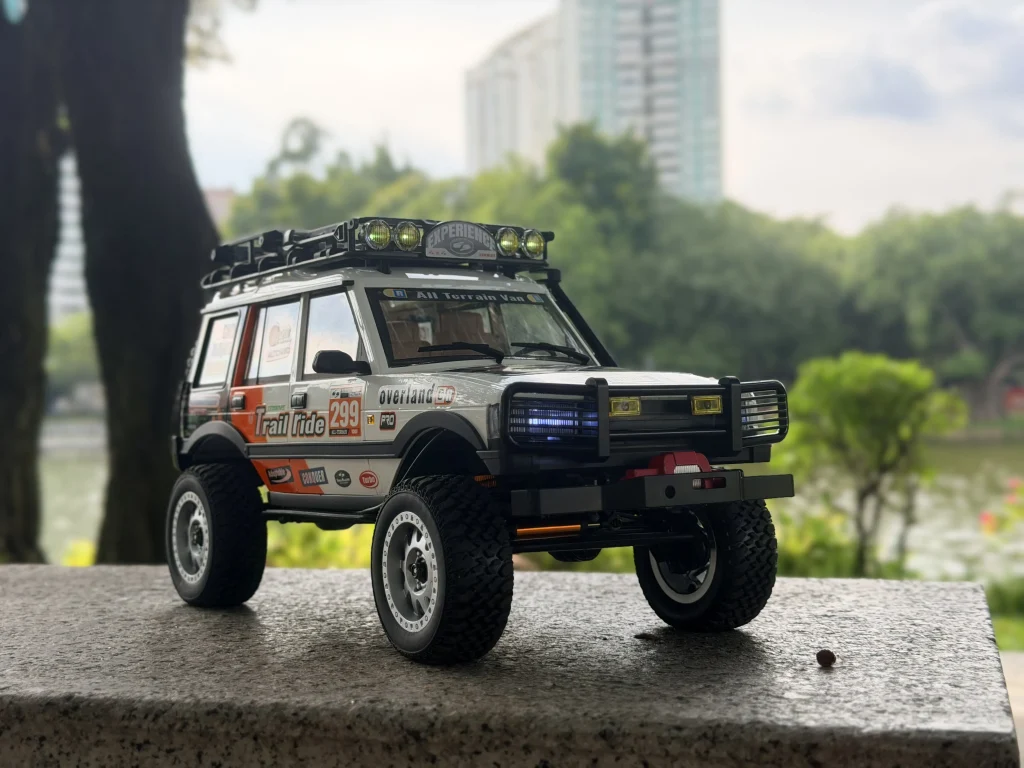
A Texas-based distributor called us last March. He had just lost two pallets of our LC80 1/12 RC crawler at the Port of Los Angeles. The containers sat in a CBP bonded warehouse for 19 days. The reason? His supplier’s lab report was five years old, and there was no Children’s Product Certificate on file.
By the time customs released the goods, the distributor had paid $9,400 in demurrage, missed the spring retail window, and lost his shelf space at two regional chains. The product was fine. The paperwork was not.
We see this kind of problem every month. RC Toy Certification US rules are among the strictest in the world. The U.S. market is the single biggest RC toy import destination, but three federal agencies touch an RC car before it reaches a shelf: the CPSC, U.S. Customs and Border Protection, and the FCC. Each one has its own paperwork.
If you are importing RC toys into the United States, you need to know what those documents are, who signs them, and what happens if they are missing. This guide covers only the U.S. market. It is built from real shipments, not marketing copy.
By the end, you will know the three certificates every RC toy needs, how the CPSC picks products for inspection, and how to verify a supplier’s paperwork is real before you wire the deposit.
The U.S. Import Compliance Framework for RC Toys
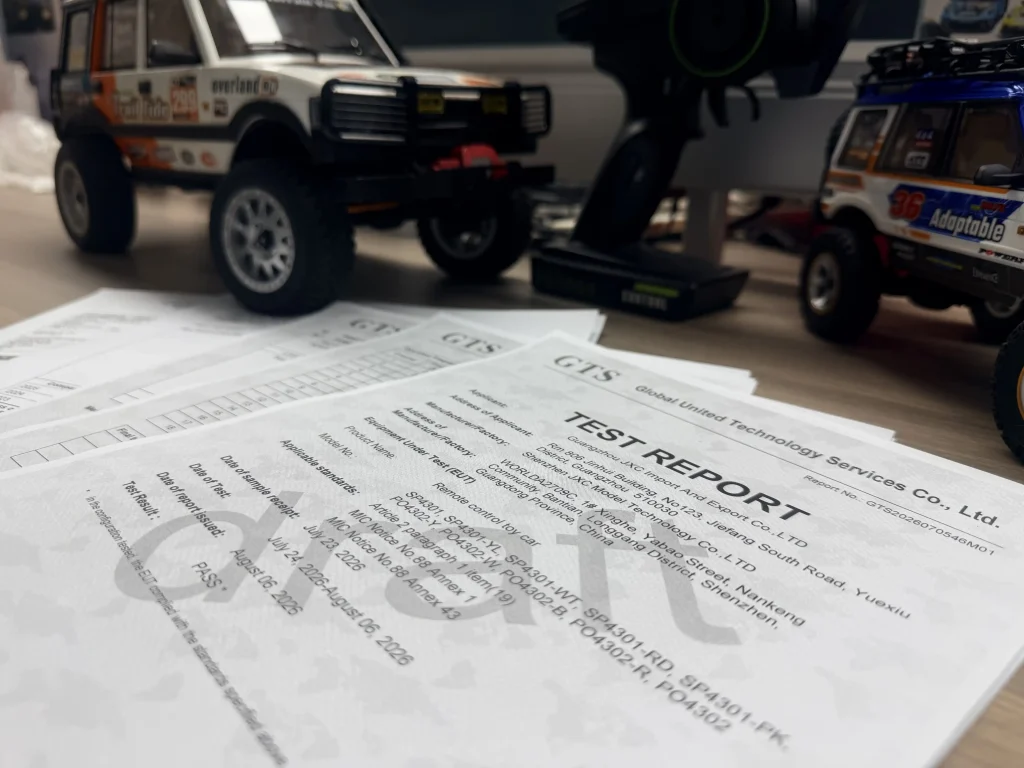
The U.S. does not use a single CE-style mark. Instead, three separate federal rules apply to an RC car at the same time. Get any one of them wrong and your shipment can be stopped, fined, or recalled.
- First, the Consumer Product Safety Improvement Act, or CPSIA. Passed in 2008, CPSIA gave the CPSC the power to set safety rules for children’s products and to require third-party testing. An RC toy that targets children under 12 falls under CPSIA by default. The law covers mechanical safety, lead content, phthalates, and small parts.
- Second, ASTM F963. This is the toy safety standard that CPSIA points to. ASTM F963-17 is the current U.S. version. It includes tests for sharp points, sharp edges, small parts, flammability, and heavy metals in paint. A factory that says its RC car is “ASTM compliant” should show a third-party test report against F963-17, not an older version.
- Third, FCC Part 15. Every RC car sold in the U.S. with a 2.4 GHz radio remote must meet FCC Part 15 rules. The remote control is a radio transmitter. The FCC treats it like a Wi-Fi device. If the transmitter is not certified, the entire toy is technically illegal to sell, even if the toy itself is perfectly safe.
On top of those three, watch out for California Proposition 65. Prop 65 is a state-level law, but California is so large it functions like a federal one. Prop 65 limits chemicals like lead and cadmium in consumer products. If you sell into California, your RC car needs to test below Prop 65 limits or carry a Prop 65 warning label.
Here is how the four pieces fit together. CPSIA is the law. ASTM F963 is the test method. FCC Part 15 covers the radio. Prop 65 covers California. The paperwork that ties them together is the Children’s Product Certificate, or CPC.
CPC, ASTM F963, and FCC: What Each Certificate Actually Requires
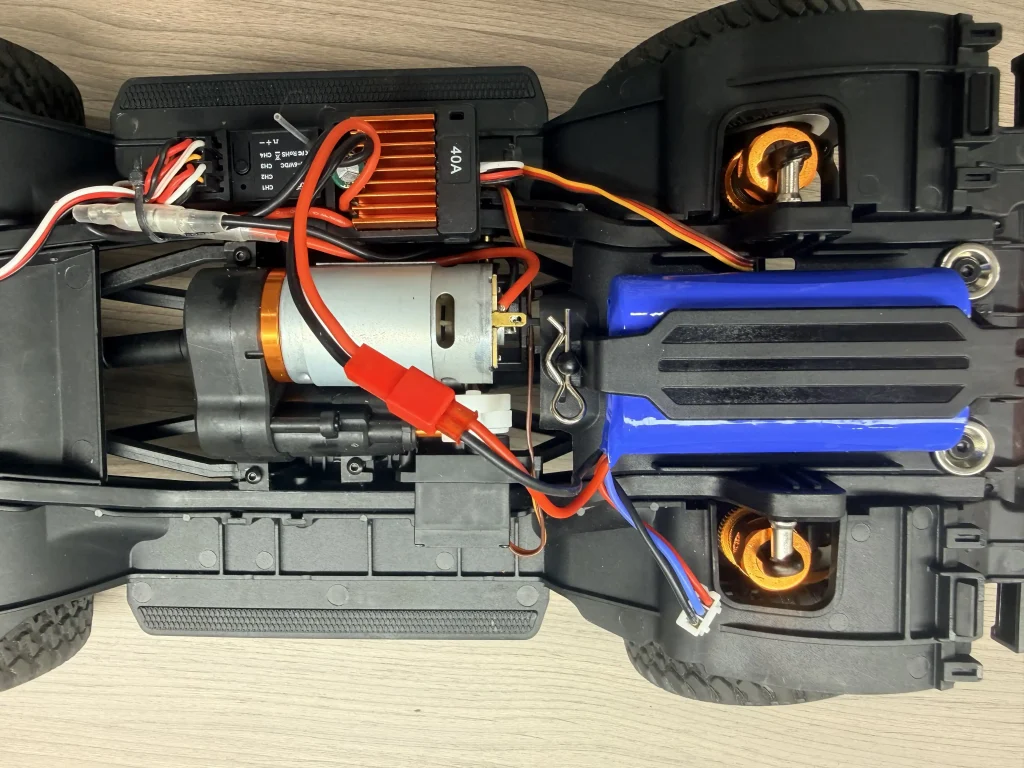
Let’s break down what each piece of paperwork contains, who is responsible for it, and what it costs if you skip it.
The Children’s Product Certificate (CPC)
The CPC is a one- to two-page document. It is not a test report. It is a formal declaration that your product has been tested by an accredited lab and meets all applicable safety rules.
The CPC must list the product name, model number, and SKU. It must identify the manufacturer and the importer. It must name every safety rule the product was tested against, and it must list the CPSC-accepted test lab that ran the tests. The importer, not the factory, signs the CPC. That signature is a legal commitment under U.S. law.
If a product has a CPC but no supporting test reports, the CPC is invalid. If the test report is from a lab that is not CPSC-accepted, the CPC is invalid. At JXC Model, we provide full ASTM F963 and FCC test reports for every model. Our U.S. distributors use those reports to issue their own CPC in about 10 minutes per SKU.
ASTM F963-17 Toy Safety Standard
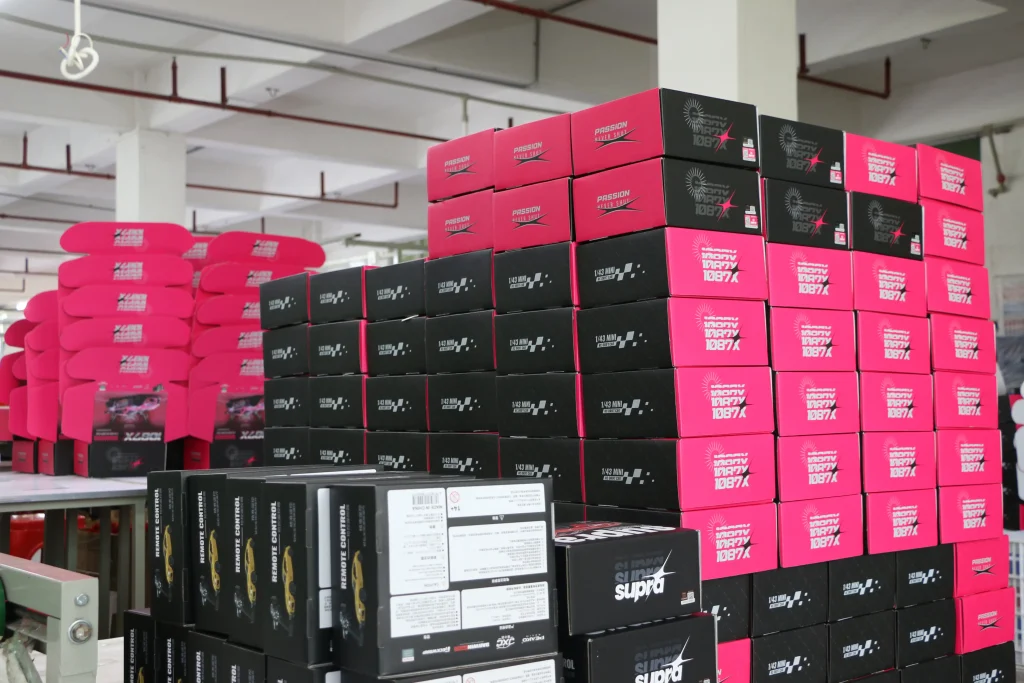
ASTM F963-17 is 78 pages long and covers 16 different test categories. For an RC car, the categories that matter most are small parts, sharp edges, battery accessibility, and paint migration.
Small parts testing uses a 1.25-inch diameter cylinder. If any part of the toy fits inside that cylinder, it is a choking hazard for children under three. Wheels, antennas, and small screws are common offenders on cheap RC designs. We removed exposed antennas from our LC80 crawler in 2024 after our lab flagged the original design. The new antenna is a flexible rubber blade.
Battery accessibility is another hot spot. Lithium-ion cells inside an RC car must sit behind a cover that requires a tool to open. A child should not be able to pop the cover and pull out the battery with bare hands. In 2023, the CPSC recalled 1.4 million toy products, and battery compartment failures were the number two cause.
FCC Part 15 Radio Certification
The remote control in your RC car is a radio transmitter. If it operates on 2.4 GHz, 27 MHz, or 40 MHz, FCC Part 15 applies. The rules cover both intentional radiators (the remote) and unintentional radiators (the receiver and motor electronics).
For RC toys, most factories use a Supplier’s Declaration of Conformity, or SDoC, for the receiver, and either SDoC or full certification for the transmitter, depending on the design. Either way, the toy must carry an FCC ID or FCC logo on the product or its packaging. If your RC car has no FCC marking anywhere, the radio is uncertified, and U.S. customs can flag the shipment.
We label every JXC remote control with the proper FCC ID. We also keep the SDoC file and the lab test report on file so our distributors can show proof of compliance if a retailer ever asks.
Here are a quick reference of the four documents and their roles in a U.S. import.
| Document | Issued By | Required For | Failure Consequence |
|---|---|---|---|
| CPC (Children’s Product Certificate) | U.S. importer (based on lab reports) | All RC toys marketed to children under 12 | CPSC fines, customs seizure, product recall |
| ASTM F963-17 Test Report | CPSC-accepted third-party lab (SGS, Intertek, TUV, UL) | Toy safety verification under CPSIA | Invalid CPC, customs detention, recall |
| FCC Part 15 Authorization (SDoC or ID) | TCB or self-declaration with lab report | Any RC toy with a radio remote control | FCC fines, retailer delisting, customs hold |
| California Prop 65 Compliance | Lab test or warning label | Sales into the state of California | State attorney general lawsuits, retailer pullouts |
What U.S. Customs Looks For and the Most Common Reasons RC Shipments Get Held
U.S. Customs and Border Protection does not inspect every container. They use a risk-based system called the Automated Commercial Environment, or ACE, to flag shipments that look suspicious. When ACE flags a shipment, CBP can hold it for document review, lab testing, or a full container devanning.
Based on what we have seen across our own distributor shipments, here are the four most common reasons RC toy containers get held at U.S. ports. For a deeper look at common sourcing problems, see our guide on sourcing RC cars from China.
The first is a missing or expired CPC. If ACE pulls up the entry and there is no CPC on file, or if the CPC lists a test date older than three years, the shipment goes to a secondary inspection. We tell every new distributor: refresh your CPC every two years, even if the standard has not changed.
The second is an FCC ID mismatch. Customs checks the FCC ID printed on the toy against the FCC’s online database. If the ID does not match, or if the ID belongs to a different product, the shipment is held. We have seen suppliers print fake FCC IDs on boxes. The numbers look real, but the database returns nothing. Always check the FCC ID at fcc.gov before you pay.
The third is small parts failures found during CPSC sampling. CPSC buys toys from retail shelves and tests them. If a sample fails, CPSC can request a recall, and the recall notice is public. In 2024, two major RC car brands received recall notices for small parts and battery issues. Both had valid CPCs. The problem was the actual product did not match the certified sample.
The fourth is Prop 65 enforcement in California. California’s attorney general has its own testing program. If they pull an RC car off a shelf and find lead above 90 ppm or phthalates above 1,000 ppm, the distributor gets a 60-day notice. Prop 65 settlements often run into six figures.
The cost of a single customs hold is rarely the customs fine. It is the demurrage, the storage, the missed sales window, and the lost trust with your retailer. A single 19-day hold in Los Angeles can wipe out the profit on an entire container.
How to Verify a Supplier’s U.S. Compliance Documents Before You Order
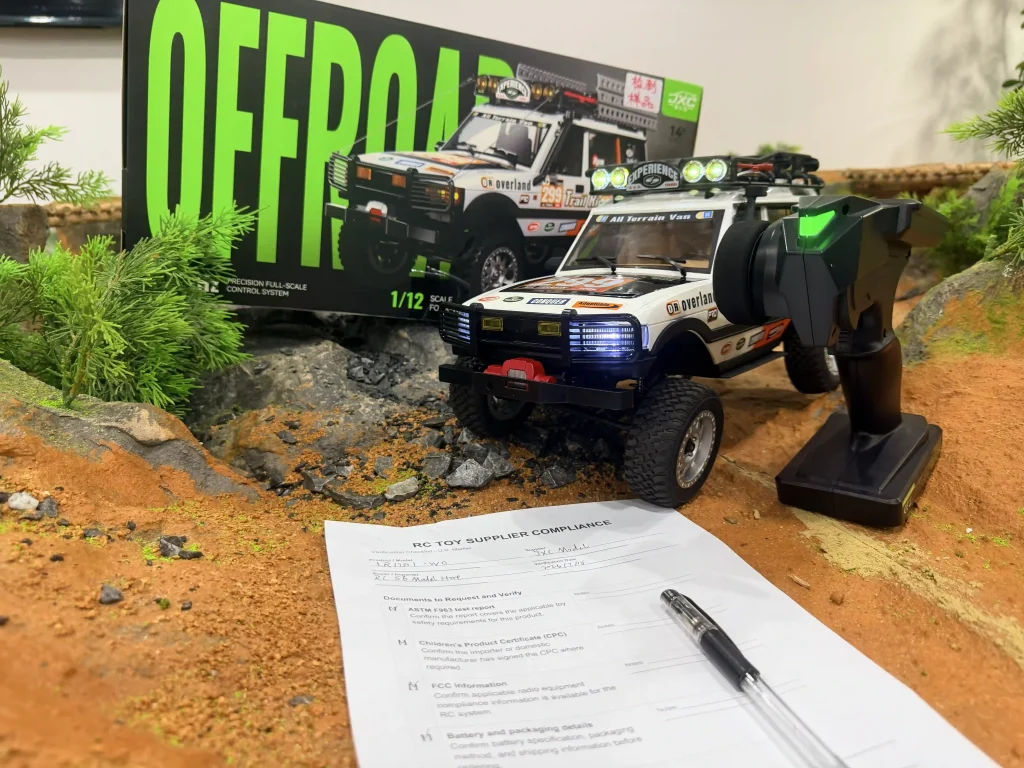
Any factory can send you a PDF that says “ASTM F963 compliant” and “FCC approved.” Some of those PDFs are real. Some are five years old. Some belong to a different product. Here is the verification process we walk every new distributor through before they place a first order.
Ask for the ASTM F963-17 test report, not just a certificate. The report should list the lab name, the test date, every clause tested, and the pass/fail result. A one-page “certificate of compliance” with no lab number is not enough.
Verify the lab’s CPSC acceptance. The CPSC maintains a list on its website. SGS, Intertek, TUV Rheinland, UL, and BV are CPSC-accepted. If the lab on the report is not on that list, the report does not count.
Match the report to the product. The report should list the exact model number, SKU, and photos of the tested product. We label every JXC test report with our internal SKU.
Confirm the FCC ID. Copy the FCC ID from the product or the report and search it at fcc.gov/oet/ea/fccid. If the ID returns no match, the radio is uncertified.
Ask who signs the CPC. The factory provides the lab reports so that you, the importer, can sign the CPC. If a supplier offers to “send you a signed CPC,” they are signing for the wrong entity. That CPC is not legally valid.
Check the test report date. ASTM F963-17 is current. A report against F963-11 or F963-08 is not enough for a 2026 shipment. We refresh our test reports on a 24-month cycle.
Request a sample before the deposit. Ship a sample to a U.S. lab and run an independent test. The cost is $400 to $700 per model. It is cheap insurance on a $50,000 order.
At JXC Model, we encourage every new U.S. distributor to do exactly that. We send some samples, we share full test reports, and we walk you through the CPC signing process. The whole pre-order check takes about a week. That is far less time than recovering from a customs hold.
If your current supplier pushes back on any of these steps, treat it as a red flag. A real factory with real U.S. compliance has nothing to hide.
U.S. RC Toy Certification FAQ
Who is legally responsible for the CPC?
The U.S. importer. The factory supplies the lab reports. The importer signs the CPC and keeps it on file. CPSIA puts the legal liability on the entity whose name is on the customs entry.
Can a single ASTM F963 test report cover multiple SKUs?
Sometimes. If two SKUs are identical except for color or minor cosmetic differences, the same report can cover both. If the chassis, electronics, or battery differ, you need a separate test.
Do I need FCC certification for the car body or just the remote?
The remote is the intentional radiator and needs FCC Part 15 authorization. The car body is an unintentional radiator, but most factories test both together for simplicity.
How long is a test report valid in the U.S.?
There is no fixed legal expiration, but the CPSC looks at the test date. Most retailers and compliance lawyers consider reports older than three years risky. We refresh our reports every 24 months.
Will JXC Model handle the U.S. paperwork for me?
We provide the ASTM F963 and FCC test reports, the FCC ID, the Prop 65 test data, and a step-by-step CPC template. Your team signs the CPC. Most of our U.S. distributors complete the paperwork in under an hour.
Have Questions About Your Next RC Order?
If you are reviewing a new RC supplier, looking for models for the U.S. market, or simply want to see what we have available, talk to us. We can send you our latest product catalogue, product specifications, and compliance documents for the models you are interested in.
Send us your SKU list, product requirements, or the market you are targeting. We will recommend suitable models, answer your questions, and discuss wholesale, distribution, or OEM/ODM opportunities based on your business needs.
At JXC Model Technology, we believe choosing the right supplier should be straightforward. Get in touch with us today, and let’s find the right RC models for your market.