
Before a single unit ships, RC toy product photos and videos are the only proof you have that the supplier’s stock matches the spec sheet — and they’re the same assets your own product listing will live or die on. A blurry hero shot or a missing underside angle costs you buyer trust, ad performance, and returns you could have avoided.
Most factory photo packs only show the toy’s quality. They do not show if the factory is real or give enough photos for a product listing. Because of this, buyers often ask for more photos but do not know exactly what photos they need.
Why RC Toy Product Photos and Videos Decide the Order Before Anyone Speaks to You
Gartner research says B2B buyers spend only about 17% of their buying time talking to suppliers. When they compare three or four factories, one factory may get only about 5% of their attention. Most of the decision happens when buyers are alone and comparing files.
For an RC toy factory, buyers cannot hold the Land Cruiser crawler, feel the tires, or hear the gearbox. They can only look at your photos and videos. So, your photo pack is very important. It shows the buyer what your product and factory are really like when your team is not there. If your photos do not answer their questions, buyers may make their own assumptions.
What product photos do RC toy buyers care about most?
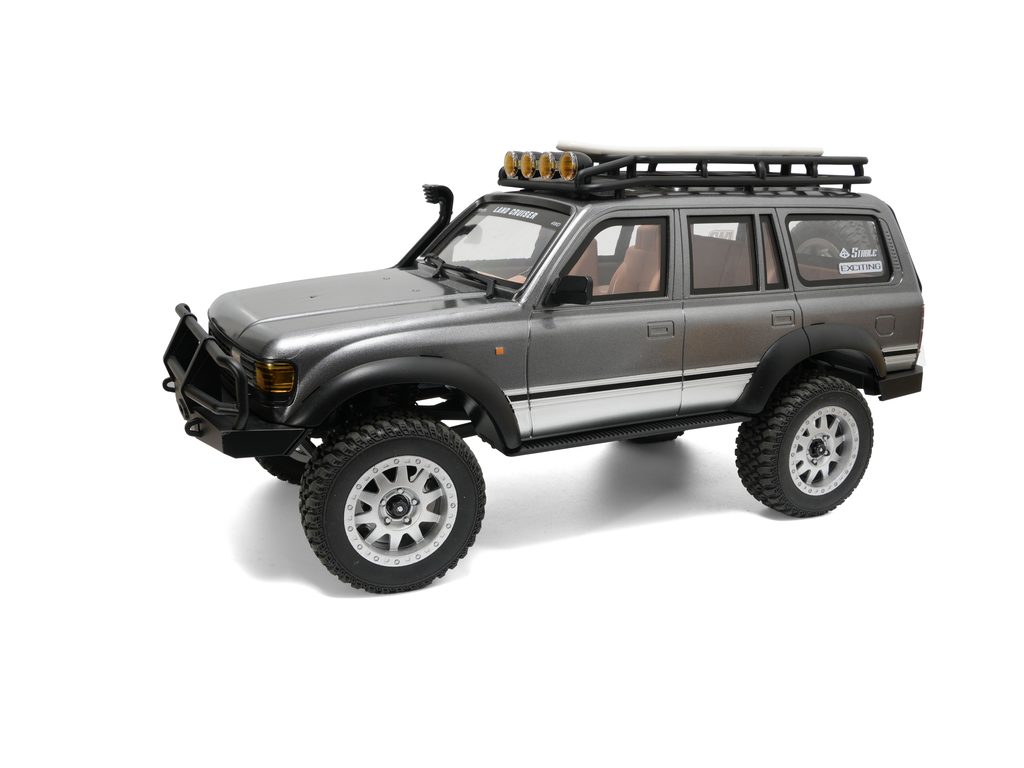
RC toy buyers care more about photos that help them feel safe than photos that only look nice. First, they want a clear product photo on a white background for their own listing. Then, they want a photo of the bottom of the chassis to see the drivetrain. They also want a clear photo of the label and warning information, plus photos of every side of the retail box. Action and lifestyle photos are less important because they do not show many useful details. When a buyer is ready to place an order, they want to make sure the product matches the details and the packaging is ready for customs. Good-looking photos alone cannot answer these questions.
| # | Shot | What it proves | Who needs it most |
| 1 | Studio hero on pure white | Product identity, marketplace listing compliance | Amazon and Shopify sellers |
| 2 | Front, rear, both sides, top | No hidden angles or unfinished faces | All buyers |
| 3 | Chassis underside | Drivetrain layout, suspension type, screw count | Distributors, hobby stores |
| 4 | Scale reference beside a known object | Real size, not photo illusion | Retail chain buyers |
| 5 | Label and mark close-up | Age grading, warnings, CE/UKCA, FCC ID, batch code | Importers and compliance staff |
| 6 | Retail box, every printed panel | Warning text, barcode, operator address block | EU and US listing compliance |
| 7 | Inner box and master carton with shipping marks | Carton quantity, dimensions, weight | Freight and warehouse teams |
| 8 | Running or action shot | Function on a real surface | Marketing and retail sell-in |
| 9 | Accessory flat lay | What is actually in the box | Returns prevention |
How do I know the supplier’s photos are actually theirs?
Wholesalers and buyers should check every factory photo. They can use Google Lens to check the photo. They may find the same photo on many supplier websites. This can mean the supplier copied the photo. The photo may not belong to the real factory. Two things worth knowing before you draw conclusions.
A photo match does not always mean fraud. A real factory may make products for many brands, so other websites may use its photos. The important thing is to check where the photo first appeared. If the photo first appeared on the supplier’s website and other websites used it later, that is normal. If the photo first appeared on another factory’s website, you should be careful.
A real factory may also have some missing photos. This is normal because some products have other customers’ brands, and the factory cannot show them. If a supplier shows you other customers’ branded boxes, you should be careful. It may show how they will treat your own brand and designs.
What to do when a photo fails the check
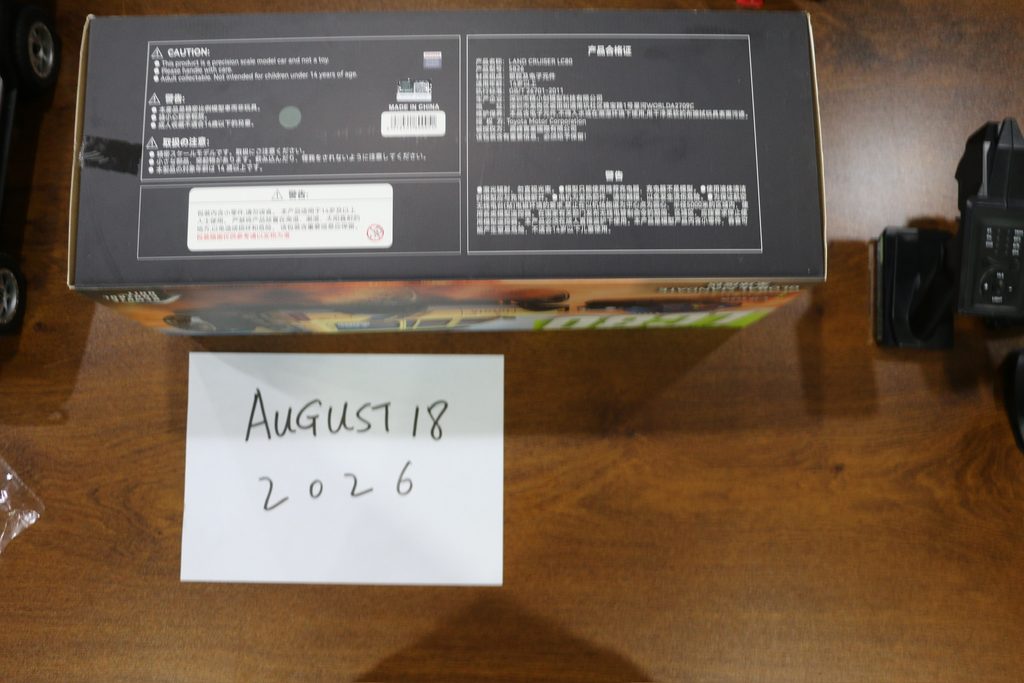
If the buyer thinks a photo may not be real, ask for a new photo of the same model. Ask the manufacturer to take the photo today and put a handwritten date in the photo. You can also ask for the same product from another angle. A real factory with its own tools should be able to take a new photo within an hour.
RC Toy Product Photos and Videos: In-Action Shots vs Studio-Only Images
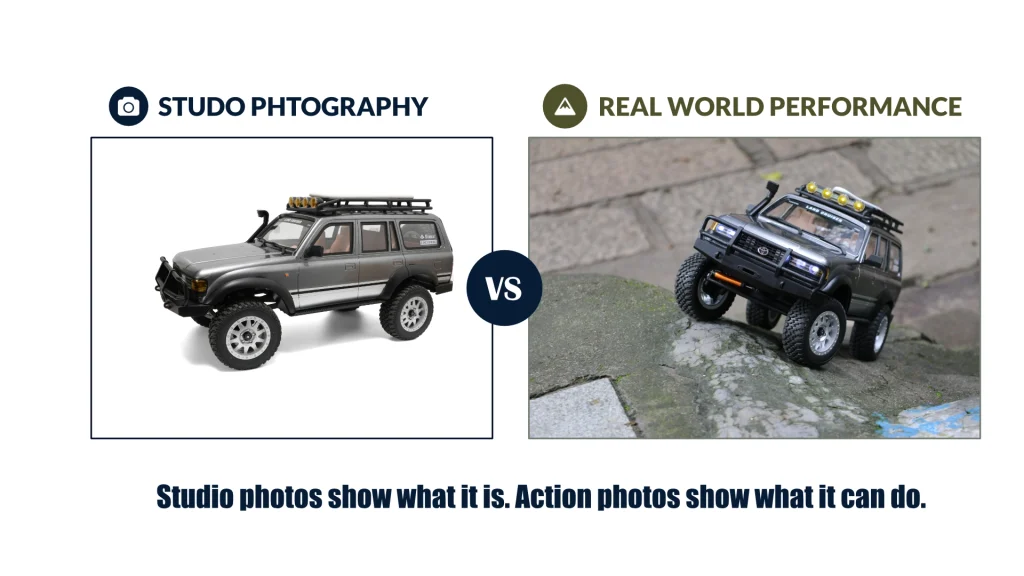
You need both studio photos and action photos because they show different things. A studio photo on a white background is good for product listings and sales sheets. An action photo shows that the RC toy really works. For example, a crawler on a white background does not show how well it can climb rocks. A photo of the crawler climbing on gravel shows this better.
What close-up details should RC toy photos include?
Buyers need clear close-up photos because they want to check the product before they order it. You should show the bottom of the chassis, suspension, axles, steering area, battery area, connector, wheels, tires, body graphics, and product markings. You should also show all markings on the toy and the box because buyers need to check every detail.
You should show the license badge or grille on licensed models because buyers need to know that the model is real and not a copy. Therefore, this photo can give buyers more confidence in the product.
You should show the battery connector clearly because buyers need to know the connector type. You should also show whether the battery comes inside the toy or separately in the box. Therefore, buyers can check the shipping and packaging requirements.
You should show the marking panel clearly because buyers need to read the age, warnings, certification marks, and product codes. You should take the photo straight on and use good light so buyers can read everything clearly. You should also use a high-quality photo because a blurry photo can hide important details. Therefore, buyers can check if the product follows the rules for their market.
How important are packaging photos for wholesale buyers?
Packaging photos are more important than product photos for wholesale buyers, because in the US and the EU the online listing itself is a regulated surface. Under 16 CFR 1500.20, a toy required to carry a choking hazard warning must also carry that warning in any internet advertisement giving a direct means of purchase, and abbreviated versions are not accepted online. In the EU, Article 19 of the General Product Safety Regulation (EU) 2023/988 requires every distance-selling offer to show a picture of the product, the manufacturer’s name and contact details, an EU responsible person where the manufacturer sits outside the EU, and warnings in the local language. You cannot build a compliant listing from a photo of the car alone.
The US warning applies depends on the age grading printed on your box. Under 16 CFR 1500.19, the small-parts choking warning covers toys and games intended for children at least three years old but under six. A model graded 6+ or 14+ sits outside that requirement. This is exactly why you need a legible photo of the age panel rather than the supplier’s word for it.
What the listing has to show, by market
| Market | What must appear in the online offer | Source |
| United States | The full choking hazard warning, where the product’s age grading and small parts trigger it. Abbreviated wording is not accepted online. | 16 CFR 1500.19 and 1500.20 |
| European Union | A picture of the product, manufacturer name plus postal and electronic address, EU responsible person if the manufacturer is outside the EU, warnings in the language of the country of sale | Regulation (EU) 2023/988, Article 19 |
| European Union, from 1 August 2030 | The digital product passport data carrier, clearly visible before purchase, including in distance sales | Regulation (EU) 2025/2509 |
What should be shown in an RC toy product video?
An RC toy video should stay short and clear because buyers want to see how the toy works. The video should be less than 60 seconds and should start with the car moving on a real surface. The video should also show a person or a normal object next to the car because this helps buyers understand the size. At the end, the video should show the battery being connected or removed. Music, drone shots, and logo animations are not needed because buyers mainly want to see the toy. Therefore, the video should make every important feature easy to see.
How do product photos help build buyer trust?
Product photos build trust when buyers can check them. A buyer trusts a photo when the sample they receive looks the same, the label in the photo matches the certificate, and a reverse image search shows that the photo comes from the supplier’s own website. Trust does not come from fancy photos. It comes when there are no surprises.
The opposite can be costly. When photos make the product look better than it really is, problems can happen after the order. These problems can include product returns, marketplace listing issues, and chargebacks. The buyer has to deal with these costs, so they may not order again.
Three simple habits can help protect the relationship:
• Photograph the golden sample, then photograph a unit from a real production run. Send both photos. The difference between them can show the real quality of the product.
• Never show a color that is not really in production. If a buyer orders a color that only exists in a computer image, it can create a problem later.
• Take new photos after any product change. For example, take new photos after new tooling, new artwork, a different battery cell, or a new certification mark on the box.
When to demand a re-shoot on a reorder
| Change | Re-shoot needed |
| New or repaired mould | Yes — full studio set |
| Packaging artwork revision | Yes — all printed panels |
| Battery or cell change | Yes — connector and marking panel |
| New certification mark added to box | Yes — marking panel |
| Colorway added | Yes — studio set for that colorway only |
| Price change | No |
What type of visuals improve conversion for RC toy listings?
The best RC toy visuals answer a buyer’s questions. A clean main photo helps the buyer notice the product. A scale photo helps the buyer understand the real size and can prevent “smaller than expected” returns. A close-up of the chassis or a special feature helps the buyer understand why the product costs more than a cheaper model. A short running video shows something that a photo cannot show, which is how the product actually works.
Marketplace rules also affect the main photo. Amazon currently asks for a pure white background (RGB 255,255,255). The product should fill about 85% of the photo. Text, logos, borders, or watermarks should not be included on the main photo.
Do product images affect search visibility now?
Yes, product images can affect search visibility more than before. Images are not only for making a page look good. They can also help people find a product. In May 2026, Google said that people can use images, files, and videos along with text in Search. Google also said that more than 16% of searches are now multimodal.
Google’s AI can look at an image and understand its objects, materials, colors, and other details. It can then use this information to find related searches. Therefore, a clear, bright, and correctly labeled product image can help buyers discover a product. It can also help the listing get more attention, not just more sales.
Google’s own image SEO documentation sets out the mechanics: images need to be crawlable in standard HTML image elements, given descriptive filenames and accurate alt text, placed near relevant text, and submitted in an image sitemap. Google does not index images referenced only in CSS. You can also attach structured data or IPTC photo metadata to each image.
How the JXC Model approaches this
JXC Model Technology makes officially licensed RC drift cars and crawler models with Toyota, Land Rover, and Mitsubishi. The company has its main office in Shenzhen and makes its products at its factory in Chenghai, Shantou. Each licensed body needs its own mould, and the factory has 12 injection moulding machines. Therefore, the product photos come from real production tools, not just prototypes.
The company also wants buyers to check the information before trusting it. Buyers can use reverse image search on the product photos. They can also ask for a factory walkthrough without telling the factory the time in advance. Buyers can also ask for a new photo of a specific model with today’s date in the photo.
If a buyer is preparing an Amazon or retail listing, the buyer should tell the company the target market. Therefore, the company can send packaging photos that match that market.
Buyers can ask about the 1:12 Toyota LC80 Land Cruiser Crawler RC Car (LC5826) or the 1:43 Toyota Supra 1087X Co-branded Drift RC Car (SP4301). They should also tell the company which market they plan to sell in.
FAQ
What product photos do RC toy buyers care about most?
RC toy buyers care most about photos that help them check the product. They need studio photos on a white background, a photo of the bottom of the chassis, a clear photo of the label and warning panel, and photos of every printed side of the retail box. These photos answer the main questions before an order. Action and lifestyle photos also help, but they are more useful for retail selling.
Should I show the RC toy in action or only as a studio image?
Both types of photos are useful because they show different things. Studio photos work well for marketplace listings and line sheets. Action photos show how the RC toy works on a real surface. The action video should stay honest. If the video needs a ramp or a camera trick, it is better to call it an advertisement instead of a product video.
What close-up details should be included in RC toy photos?
RC toy photos should show the bottom of the chassis, suspension, axles, steering area, battery compartment, connector, wheel hex, tire tread, graphics, and product markings. Licensed models should also show the license badge. The markings should be clear and easy to read. Therefore, photos should be taken straight on with good and even light.
How important are packaging photos for wholesale buyers?
Packaging photos can be very important for wholesale buyers because they help buyers prepare their listings. US rules can require choking hazard warnings in online advertising for certain products. EU rules can also require product pictures, contact details, and warnings in local languages. Therefore, clear packaging photos can help buyers check the information before selling the product.
What should be shown in an RC toy product video?
An RC toy video should show the product’s function, size, and battery setup in less than 60 seconds. The video should show the car moving on a real surface, turning in both directions, and showing its special features. It should also show a person or common object next to the car so buyers can understand its size. Finally, the video should show the battery compartment. Music and logo animations are not necessary because buyers want to see the product work.
How do product photos help build buyer trust?
Product photos build trust when buyers can check them. The sample should match the photo, the label should match the certificate, and the photo should belong to the supplier. Therefore, factories should photograph both the golden sample and a real unit from production and send both photos. This gives buyers a better idea of the real product quality.
What type of visuals improve conversion for RC toy listings?
Good visuals answer a buyer’s questions. A clean main photo helps get attention. A scale photo helps buyers understand the size and can prevent returns. A close-up of a special feature helps explain the price. A short running video shows how the product works. Therefore, each photo should have a clear purpose.
How can I tell if a supplier’s photos are stolen?
You can use Google Lens, TinEye, and Yandex to check supplier photos. If the same photo appears on many supplier websites, you should check where it first appeared. A photo that first appears on the supplier’s own website may be normal. However, a photo that first appears on another factory’s website can be a warning sign. Therefore, always check the original source before trusting the photo.
Should I ask for a live video call as well as a product video?
Yes, because the two videos show different things. A product video shows that the RC toy works. A live factory walkthrough shows that the factory exists. Ask the supplier to show the model you want to buy and show different parts of the factory. You can also save screenshots from the call and compare them with the supplier’s photos later.
Do product images affect search visibility?
Yes, product images can also help with search visibility. Google Search can now use images and videos as search inputs, and Google has said that more than 16% of searches are multimodal. Google’s systems can look at objects, materials, and colors in images. Therefore, suppliers should provide original image files, one photo for each angle, and clear file names.